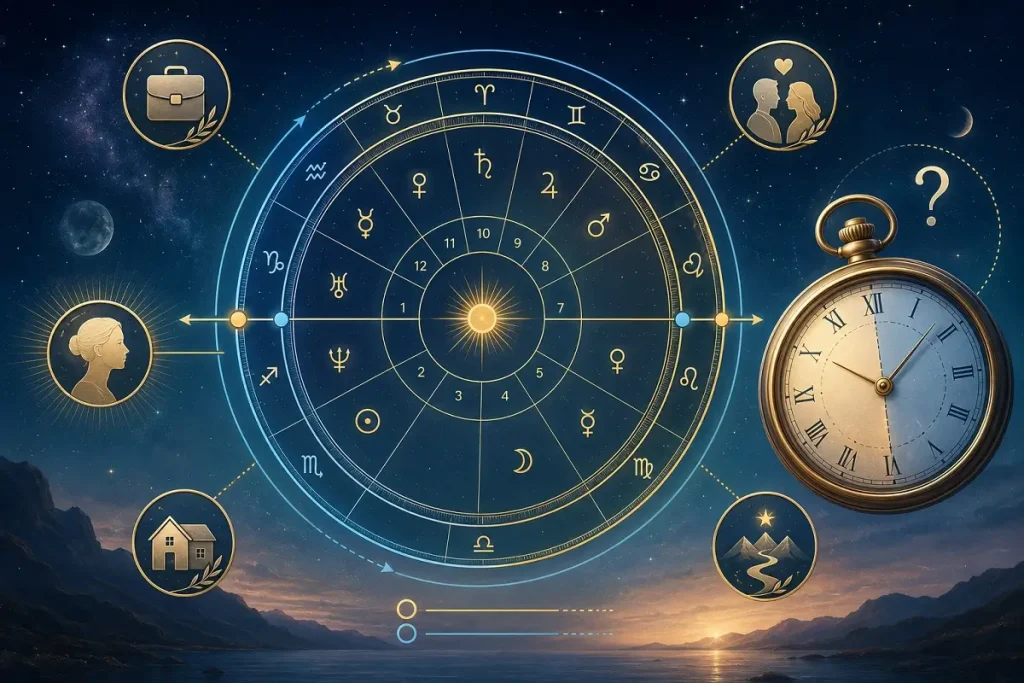
Why Do Major Planetary Transits Last Longer?

Subject Content
Why is transit time related to the speed of the planet?
Heavy planetary transits last a long time because these planets move slowly along the Zodiac, affecting the same degree area for an extended period, and can touch the same point multiple times through retrograde motion.
in astrology heavy planetary transits When this is mentioned, it usually refers to the movements of Jupiter, Saturn, Uranus, Neptune, and Pluto in the birth chart. Some of these planets describe social order, while others represent generational changes. However, their common point is this: unlike fast-moving planets, they don't just come and go in a few days. They remain in a sign, a house, or in an aspect they form with the natal planet for a longer period.
Therefore, a heavy planetary transit isn't like a sudden flash of lightning; it's more like the gradual change of seasons. When the Sun aspects a natal planet, a noticeable emphasis can develop over a few days. Moon transit Sometimes it can change a mood in just a few hours. But Saturn, Uranus, Neptune or Pluto When a topic is touched upon, it doesn't immediately end. First, it gives a signal, then it expands the theme, and then it pushes the person to make a decision or develop awareness.
To better understand this process, first Transit Map Calculation Using a astrological chart, it's necessary to examine which houses the heavy planets are transiting in your birth chart and which natal planets they are aspecting. This is because the effect of a prolonged transit is not the same for everyone; the area of the chart it touches is the determining factor.
What does "Heavy Planet" mean?
The term "heavy planet" is used for planets that move slowly through the sky and whose effects extend over a longer period of time.
In astrology, when we consider planets according to their speeds, we see two fundamental differences. Moon, Mercury, Venus ve Mars They work faster. They can trigger everyday reactions, short-term decisions, communication, momentary fluctuations in relationships, motivation, and the need for action more quickly.
Heavy planets, on the other hand, move more slowly, thus confronting the individual with longer-term themes. The transits of these planets often involve:
• direction of life,
• responsibilities,
• maturing in relationships,
• professional structure,
• the need for liberation,
• coping with uncertainty,
• power balances and
• deep transformation processes
It works via.
The important point here is this: A transit of a major planet doesn't always mean a "big event". Sometimes, there isn't a major development externally, but internally, the person passes through a very important threshold. For example, when transiting Saturn squares the natal Moon, the person may enter a more serious period regarding family, trust, emotional burdens, or responsibilities. This process may appear as just "intensity" from the outside; however, internally, it becomes difficult for the person to continue with old habits.
How Does Planetary Slowing Extend Transit Time?
The longer a planet takes to complete one orbit around the Sun, the slower it moves through the Zodiac.
Astronomically Jupiter It completes its orbit around the sun in approximately 12 years. Saturn in approximately 29 years, Uranus in approximately 84 years, Neptune in approximately 165 years and Pluto It completes approximately every 248 years. This difference directly affects astrological transit times. Fast-moving planets pass through a degree area quickly, while heavier planets can highlight the same area for months, or even years in some cases.
Let's think of this in a simple analogy. Someone riding a bicycle down a street appears briefly and then disappears. If a heavy construction vehicle passes through the same street, it moves slower and leaves a more noticeable trail. Heavy planetary transits are similar. When a transit hits a sensitive point in the birth chart, it doesn't just "touch and pass"; it works on that area, brings it back to the forefront, and gives the person a more lasting perspective on the matter.
Therefore, you can visit our long-term transits When interpreting zodiac signs, simply asking "which planet is in which sign?" is not enough. The real questions are:
• Which house is the transiting planet passing through in the birth chart?
• Which natal planet does it form an aspect with?
• Is the angle approaching, finalized, or receding?
• Will it return to the same point with the retrograde movement?
• Are there any other strong transits, eclipses, or progressive indicators during the same period?
When these questions are not considered together, the impact of a major planetary transit is either exaggerated or not fully understood.
Why does retrograde motion prolong heavy transits?
Retrograde motion prolongs the transit process because it causes the heavier planet to repeatedly return to the same degree area.
One of the main reasons why heavy planetary transits last so long is retro movement A planet can make an aspect to a natal planet while moving directly forward. Then, during its retrograde period, it can return to the same degree. Later, when it moves forward again, it can pass through the same point a third time.
Therefore, many heavy planetary transits work in three stages:
• First contact makes the subject obvious.
• Retro themes delve deeper into the subject.
• The last contact highlights the need to develop a decision, outcome, or new approach.
For example, if transiting Saturn is in opposition to natal Venus, the person may begin to think more seriously about relationships, sense of self-worth, financial security, or commitment. Problems become apparent upon initial contact. Retro contact The person questions, "Can I really handle this relationship, this expense, this commitment, or this expectation?" At the final point of contact, the need for a more realistic decision becomes apparent.
Therefore, a heavy planetary transit is not limited to a single day. The exact day of the aspect is important; however, the process usually begins before that day and continues for some time afterward. This topic... What happens when a transiting planet forms an aspect with a natal planet? This can be discussed in more detail in the article.
Why do Saturn transits last so long?
Saturn transits last a long time because Saturn moves slowly, matures the matter, and demands concrete structure from the individual.
Saturn In astrology, time is associated with responsibility, boundaries, effort, structure, and maturity. Therefore, when a Saturn transit occurs, a person often feels, "I need to take this seriously now." Saturn demands a solid foundation rather than quick results.
Saturn transit This can be particularly pronounced when it touches significant points such as the natal Sun, Moon, Venus, Mars, ASC, or MC. For example, when transiting Saturn squares the natal Sun, a person may feel more tired, under pressure, or overwhelmed with responsibilities. However, this transit doesn't only mean difficulty. When used correctly, it provides discipline, resilience, and realistic direction.
The prolonged nature of Saturn's influence is actually its way of teaching. If a problem were solved immediately, a person would simply be done with the day's issue. But when Saturn prolongs the process, the person;
• setting boundaries,
• taking responsibility,
• to reduce excess and
• establishing a permanent order
learns.
Therefore, Saturn transits are often not about quick relief, maturation process It brings about a situation where, ultimately, a person can build a simpler, more realistic, and more resilient structure.
Why does the Uranus transit span years?
Uranus transits last a long time because Uranus moves slowly and changes a person's accustomed routine gradually, not all at once.
Uranus It is associated with liberation, unexpected developments, sudden realizations, independence, and the need for a change of direction. However, since Uranus is a heavy planet, this change doesn't always happen overnight. Sometimes, a person first feels uneasy. Then they realize that the current situation is restricting them. After that, they turn to new options.
Uranus's transit through a house takes, on average, years; Uranus transit Because it works particularly slowly in house systems, it can keep the relevant issue in a person's life on the agenda for a long time. Astrological sources state that Uranus's transit through a house can take approximately 7 years on average; this duration can vary depending on the house system, the size of the houses in the birth chart, and retrograde movements.
For example, Uranus 10th house If someone is going through this phase, they may want to make more independent decisions about their career, social standing, goals, and professional direction. This doesn't always mean changing jobs. Sometimes they do the same job but change their working style. Sometimes they seek a more flexible career path. And sometimes they want to bring a talent they've been putting off for years into their professional field.
Because the Uranus transit is long-lasting, the person first becomes aware of the pattern that bothers them, then sees the alternatives, and then begins to try the new arrangement.
Why can a Neptune transit feel uncertain?
Neptune transits last a long time because Neptune slowly softens boundaries, causing one to question things they thought were certain.
Neptune, Unlike Saturn, it doesn't concretize; rather, it dissolves, refines, sensitizes, and sometimes creates uncertainty. Therefore, a Neptune transit can be challenging for those seeking quick results. Because Neptune's language isn't clear commands, but intuition, resolution, ideals, and the search for inner direction.
For example, Neptune 7th house If this phase is occurring, relationships may involve idealization, viewing the other person differently than they are, blurring the lines between self-sacrifice, or experiencing ambiguous relational processes. During this process, the individual may more frequently ask themselves, "What am I truly committed to?"
Neptune transit Because it takes a long time, it's not always easy for a person to make a decision immediately. This is because Neptune first softens old clarity. A person may feel like they're walking on a foggy road for a while. But this fog isn't entirely negative. Sometimes, during this process, a person becomes aware of emotional needs, ideals, and sensitivities they hadn't seen before.
The most important point when working with a Neptune transit is this: instead of making big decisions based solely on emotions, it's necessary to support them with concrete data. Because Neptune can provide inspiration; however, when boundaries weaken, it can also make one prone to misjudgment.
Why does a Pluto transit have such a profound effect?
Pluto transits are long because they move very slowly and bring to light issues that lie at the root, not those that are superficial.
Pluto In astrology, Pluto is associated with themes of power, control, crisis, purification, transformation, psychological depth, and restructuring. When a Pluto transit touches a natal planet or a significant point in the chart, the individual often cannot be satisfied with superficial solutions. This is because Pluto prompts the question, "Why has this issue gained so much power?"
Pluto transits Sometimes it becomes apparent through external circumstances; other times, the individual confronts internal power, fear, dependence, resistance, or the need for control. Because this process is lengthy, the person doesn't have to change suddenly. However, over time, it becomes clear that old attitudes are no longer effective.
For example, a strong Pluto transit to the natal Moon can cause a person to delve deeper into family ties, the need for security, emotional responses, and defense mechanisms carried over from the past. A Pluto transit to the natal Venus can intensify issues of possessiveness, commitment, self-worth, or material sharing in relationships.
The prolonged duration of Pluto provides time for a fundamental approach to the issue. Therefore, Pluto transits are often not about "rapid change," deep transformation process.
Do heavy planetary transits affect everyone the same way?
The same heavy planetary transit does not produce the same result for everyone; the houses, aspects, and natal planetary connections in the birth chart determine the outcome.
One person might experience transiting Uranus in their career sector, while another might experience the same Uranus period through relationships, family, education, or health. This is because the influence of the transiting planet is shaped by its placement in the birth chart.
Therefore, it's not accurate to say "Pluto in Aquarius means everyone will experience the same thing." Common themes may emerge at the societal level; however, where this influence falls in a personal chart should be evaluated separately. A heavy planetary transit becomes more pronounced if it touches personal planets, the Ascendant, the Midheaven, or major house rulers.
In interpreting transit transits, the following points should be considered together:
• The nature of the transiting planet
• The theme represented by the natal planet
• Type of angle
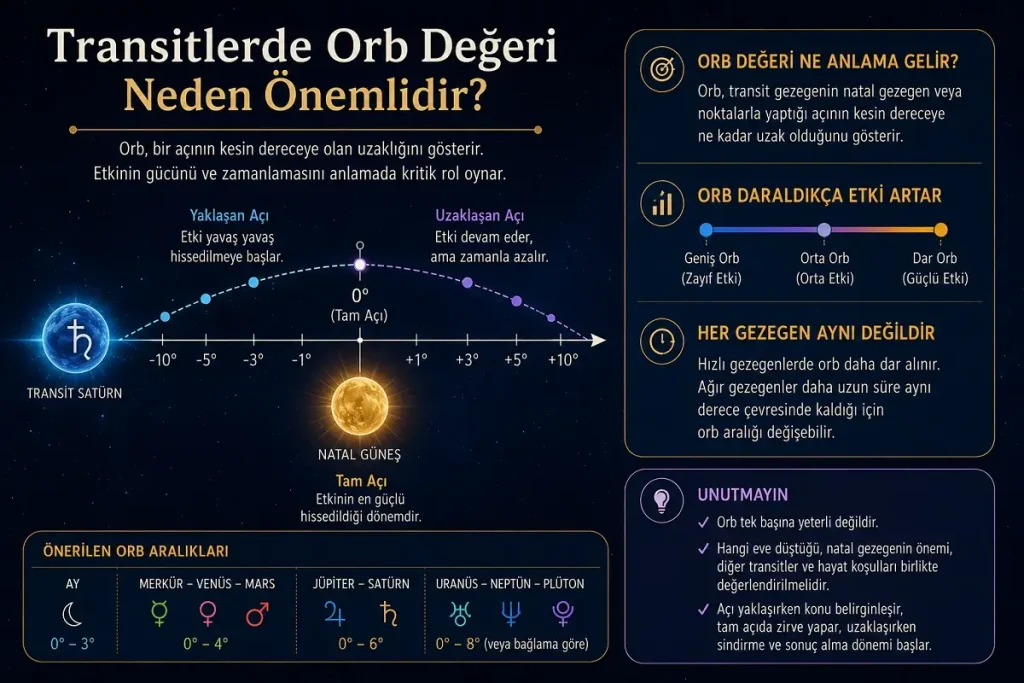
• Orb value
• Home connection
• Retro repetitions
• General period indicators on the map
Therefore, you can visit our Which planets are most important in a transit chart? This topic can be considered a natural continuation of that of this article. The reason why heavier planets are given more attention is related to their association with both slow and enduring themes.
In heavy transit, is the event or the process more important?
During intense planetary transits, what matters is not so much the single event itself, but rather the process it leads the individual through.
The biggest mistake made when evaluating heavy transits is attaching too much importance to the exact day of the aspect. Of course, the day of exact aspect is important; however, in heavy transits, the issue usually begins earlier. The person first feels restlessness, pressure, a search for direction, uncertainty, or a need for decision. Then, external circumstances can make this internal process visible.
For example, if transiting Saturn squares natal Mars, the individual may encounter obstacles related to workload, low energy levels, anger management, or achieving goals. However, the real issue isn't just the events of that day. Here, Saturn shows the individual how to use their energy more effectively, develop patience, and understand the consequences of acting without a plan.
During intense transits, the event is often only the visible part of the process. The real work happens here:
What did the person notice?
Which habit does he/she need to break?
• In which area should one behave more maturely?
• What kind of realistic plan should be made?
Which boundary should be drawn more clearly?
Therefore, a heavy planetary transit should be evaluated not only with the question of "what will happen?", but also with the question of "what does this process want me to change?".
How to Interpret Heavy Planetary Transits More Accurately?
To properly interpret significant transits, one needs to look at the whole chart, not just a single indicator.
It's not wise to panic during intense planetary transits. These transits aren't designed to turn a person's life upside down overnight, but rather to bring to light issues that have needed time to mature. Of course, some periods can be challenging; however, not every challenge leads to the same outcome.
For a sound interpretation, the first step is to determine which house the transiting planet is passing through. Then, the aspects it forms with natal planets are examined. Finally, the orb of this aspect, whether it's approaching or retreating, and whether it will recur in retrograde motion are assessed.
For example, if transit Neptune squares natal Mercury, mental disarray, difficulty making decisions, misunderstandings, or unclear information may arise. However, if Saturn forms a supportive aspect during the same period, the individual can balance this uncertainty with more solid plans. In other words, no single transit explains the whole picture.
The healthiest approach when interpreting a heavy planetary transit is this: the sky shows a theme to the individual; however, the individual's conscious choices largely influence how that theme is experienced.
general evaluation
Heavy planetary transits last a long time because they move slowly, bring up the same issues repeatedly through retrograde cycles, and create more lasting awareness in a person's life.
Heavy planetary transits should not be considered short-lived effects. When Saturn, Uranus, Neptune, and Pluto particularly touch significant points in a personal chart, the process can last for months, sometimes years. This is not only because of the slow pace of the planets themselves, but also because the themes they represent are not easily consumed.
Saturn fosters structure. Uranus indicates the need for liberation. Neptune enhances intuition and sensitivity amidst uncertainty. Pluto makes areas of deep transformation visible. Each of these planets demands a different level of consciousness from the individual.
Therefore, you can visit our Why do heavy planet transits last so long? The answer to this question is both astronomical and astrological. Astronomically, these planets move slowly. Astrologically, however, the themes they represent are connected to deeper, more lasting, and longer-term processes of change in a person's life.
For the most accurate assessment, transits should be considered not in isolation, but within the context of the complete birth chart. This is because the same celestial movement might manifest as a career change for one person, while for another it might represent changes in relationships, family, education, healthcare, or inner awareness.
Frequently Asked Questions
The most frequently asked questions about heavy planetary transits are how long these effects last and whether they produce the same results for everyone.
Why do intense planetary transits last so long?
Heavy planetary transits last a long time because planets like Jupiter, Saturn, Uranus, Neptune, and Pluto move slowly through the Zodiac. When these planets touch a point in a birth chart, the effect is not limited to just a few days. Especially if there is retrograde motion, the same degree area can be triggered more than once. Therefore, heavy planetary transits describe the process rather than the event itself.
Which planets are considered heavy planets?
In astrology, when referring to heavy planets, Jupiter, Saturn, Uranus, Neptune, and Pluto are generally considered. Jupiter and Saturn are primarily regarded as social planets, while Uranus, Neptune, and Pluto are associated with generational influences. In a personal chart, these planets can have a more pronounced effect if they are in contact with significant points such as the natal Sun, Moon, Venus, Mars, ASC, or MC.
How long does a Saturn transit last?
A Saturn transit can be felt for several months, depending on the type of aspect and the orb value. If it's retrograde, it may touch the same natal point multiple times, making the process longer. Saturn transits generally bring up issues of responsibility, boundaries, effort, order, and maturity. Therefore, it's important to look not just at the exact day of the aspect, but at the entire process.
How many years does a Uranus transit last?
Uranus transits, especially during house transits, can span years. An aspect to a natal planet, depending on retrograde motion, can have an effect lasting for months. A Uranus transit can increase a person's need to break free from familiar patterns, seek liberation, make different decisions, and renew the existing order. This effect doesn't always mean a sudden break; sometimes it functions as a process of inner awakening.
Why does a Neptune transit create uncertainty?
A Neptune transit can create uncertainty because Neptune softens boundaries, reduces certainties, and leads one to a more intuitive realm. During this period, it may be difficult to make clear decisions on certain matters. However, a Neptune transit doesn't just mean confusion; it can also enhance sensitivity, inspiration, empathy, and the search for inner direction.
Why does a Pluto transit feel challenging?
A Pluto transit can feel challenging because it brings to the forefront deeper issues than superficial ones. Themes of power, control, dependence, fear, crisis, and transformation may become more visible. Pluto can guide a person to let go of old defense mechanisms and develop a stronger inner stance. Because this process is lengthy, its effects are profound.
Does a transit of a major planet definitely bring about significant events?
A heavy planetary transit doesn't always bring about a definite event. Sometimes it's an external development, and sometimes it's a powerful internal awakening. Whether or not an event occurs depends on the nature of the transiting planet, the aspects it makes, the house connections in the birth chart, and other indicators during the same period. Therefore, it's not accurate to make a definitive judgment based on a single transit.
Do major planetary transits affect everyone the same way?
No, heavy planetary transits don't affect everyone the same way. Even if the same transit is common to everyone in the sky, it touches different houses and different natal planets in the birth chart. Therefore, while one person might experience the same transit in their career area, another might experience it through their relationships, family, finances, education, or health.
Is the orb value important in heavy transits?
Yes, the orb value is quite important in heavy transits. The effect becomes more pronounced as the planet approaches the natal point. The exact aspect time can be one of the most intense periods; however, with heavy planets, the effect is not limited to the exact degree. Approaching, exact, and receding phases should be considered together. If there is retrograde motion, the orb area may become active again.
How to track major planetary transits?
To accurately track significant planetary transits, both the birth chart and the current transit chart must be examined together. The house the planet is transiting, the aspects it forms with natal planets, its orb value, its retrograde motion, and other indicators from the same period should all be considered. This ensures that the transit is not merely a general interpretation, but becomes more meaningful in the context of the individual chart.

WRITE A COMMENT
VISITOR COMMENTS - 0 COMMENTS