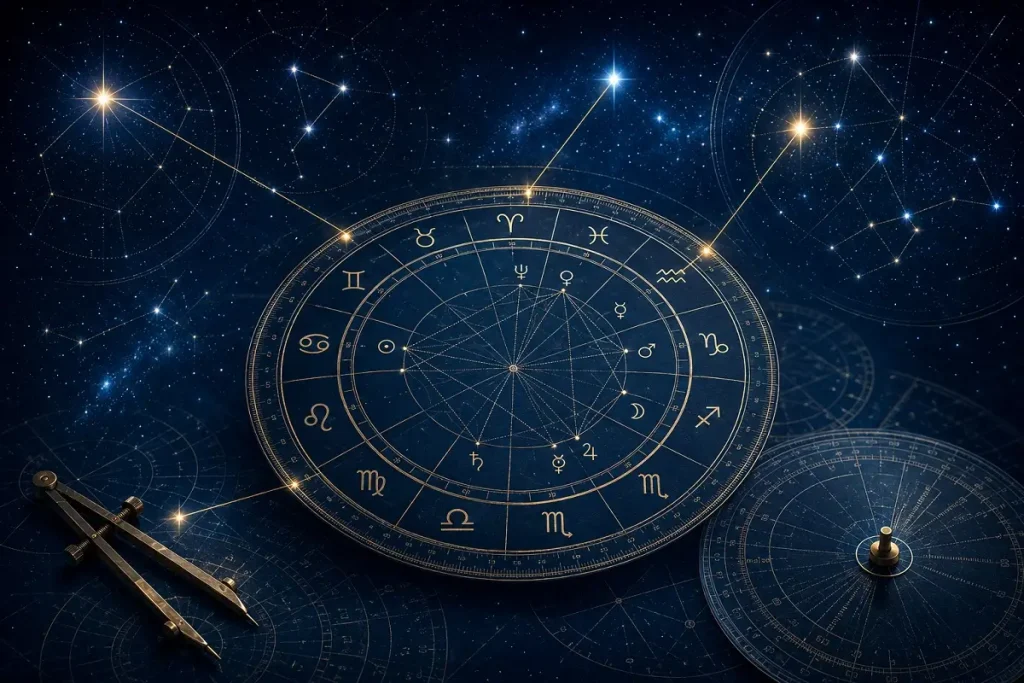
When does the transit effect begin and end?

Subject Content
How to Understand the Beginning and End of a Transit Effect?
When does the transit effect begin and end? The short answer to this question is: The transit effect usually begins when a planet approaches a planet, house, or significant point in the natal chart within a certain orb range; it reaches its strongest level when the aspect is exact; its effect diminishes as the planet moves away. However, this duration is not the same for every planet. Moon transit It may be felt and pass within a few hours, Saturn, Uranus, Neptune ve Pluto The influence of heavy planets like these can work in waves for months, or even years in some cases.
The duration of transits is not determined by a single date, but by factors such as the planet's speed, orb value, and the approach, exactness, and departure of the aspect.
Understanding transits isn't simply about saying "there's an exact aspect today." For example, if transit Mars is approaching a square aspect with natal Mercury, a person might start speaking more impulsively, making quick decisions, or experiencing mental tension a few days before the exact aspect. On the day of the exact aspect, the issue may become more apparent. As the aspect moves away, the tension decreases; however, if the person made a decision or had an argument during that period, the consequences may continue afterward.
Therefore, in transit interpretation The beginning, peak, and resolution process. They should be read together. For the most accurate assessment, it is necessary to look at which house the transiting planet is passing through, which natal planets it is forming aspects with, and whether there are any other supportive or challenging indicators in the chart during the same period.
Does the transit effect begin before the exact angle?
A transit is often felt even before the exact aspect day, because the planetary energy gradually approaches.
Yes, the transit effect often begins just before the angle fully appears. This... approaching angle effect It is said that as a planet moves towards a planet or point in the natal chart, the subject represented by that planet gradually comes to the forefront. This can sometimes be felt as a development in the external world, and sometimes as internal restlessness, awareness, the need to make decisions, or the revival of a pending issue.
For example, if transiting Saturn is approaching a square aspect to the natal Sun, a person may begin to think more seriously about issues related to responsibility, burden, discipline, career, or a father figure weeks before the exact aspect day. The exact aspect day is generally considered symbolically intense; however, real-life developments may sometimes become apparent before the exact aspect, sometimes in the days leading up to it, and sometimes afterward.
Therefore, the approach of saying "the effect will only occur on this day" regarding transits is misleading. The exact date of the angle is important, but its impact is much broader. Especially with heavier planets, the process doesn't work like a door suddenly opening, but rather like a phase that gradually unfolds.
When is the transit effect strongest?
The transit effect is usually felt most intensely around the days when the aspect is exact.
The time when a transit is strongest is usually when the planet is in relation to the natal planet or point. It is the period when it reaches its full potential. This is called the completion of the angle. However, this power doesn't always signify an external event. Sometimes, a person makes decisions, experiences awareness, clearly sees something, or feels the weight of a process that began earlier.
For example, if transit Jupiter forms a trine aspect with natal Venus, the person may feel relief in social relationships, receive support, and experience financial or emotional comfort. However, this doesn't necessarily mean a great opportunity is about to present itself. The outcome will depend on which house Venus rules in the chart, which house it's transiting through, and what other aspects are present during the same period.
The type of angle is also important. conjunction, square ve anti- Angles can produce more visible effects. Triangle ve sexagesimal However, aspects can often function as more supportive opportunities, but they also wait for the individual to take action. angles in astrology You can find detailed information about angles from this link.
When does the transit effect end?
The transit effect diminishes when the planet leaves the orb range; however, the consequences of decisions made during this period may take longer to manifest.
Transit effect The planet's influence weakens as it moves further away from the angle it forms with the natal point. diverging angle effect It is said that when the planet moves away from the same degree area, the pressure, activity, or visible effect of the transit decreases. However, this does not necessarily mean that the issue is completely closed.
For example, if transiting Mars has triggered a discussion on a particular issue, the tension may lessen when Mars moves away; however, the matter discussed may still need to be addressed later in terms of relationships, work, or family life. Similarly, if transiting Saturn has brought a responsibility to light, the individual may continue to work with the consequences of that responsibility after the aspect ends.
Therefore, it is healthier to consider the end of the transit in two separate ways:
- Astrological influence diminishes: The planet exits the orb range.
- The life cycle can continue: The issue raised during transit will progress to its natural conclusion.
So the transit ends, but the issue it brought to light may remain in life for some time longer.
How does time vary on fast and slow planets?
The speed of the planet directly affects transit time; faster planets have shorter transit periods, while slower planets have longer transit periods.
Transit duration This varies significantly depending on the planet. Faster-moving planets like the Moon, Mercury, Venus, and Mars can have a quicker impact on daily mood, communication, relationships, motivation, and short-term decisions. These effects are usually short-lived; however, they can become more noticeable if they trigger a sensitive point in a person's natal chart.
Jupiter ve Saturn These planets exert longer-term effects. Jupiter works through growth, expansion, opportunity, and the search for meaning; while Saturn emphasizes responsibility, structuring, boundaries, patience, and maturity. Uranus, Neptune, and Pluto, on the other hand, describe much longer-term processes. These planets are often associated not with a single event, but with periods of change, resolution, awakening, transformation, or deep awareness in a person's life.
Retrograde motions can also prolong the process. If a planet contacts the same natal degree three times, the effect usually works in three stages: the first contact initiates the matter, the retrograde contact brings the issue back to the forefront, and the final contact makes the course of events more distinct. To see these stages in your personal chart... transit map calculation You can use the vehicle.
Does the transit effect last the same amount of time for everyone?
The duration and intensity of transits vary according to individual charts; the same transit will not produce the same result for everyone.
No, the transit effect is not felt with the same intensity or duration by everyone. This is because the degrees, house placements, aspects, and ruling planet connections of the planets are different in every birth chart. The same Saturn transit might increase career responsibilities in one person, while in another it might highlight themes of family structure, health sensitivities, education, relationships, or financial security.
One of the most important points here is what the planet the transit is in contact with represents in the natal chart. If the transiting planet aspects the natal Moon, emotional areas, family, the need for security, and habits may be more affected. If it aspects the natal Mercury, mental processes, communication, education, business, correspondence, or decisions may come to the forefront. If it aspects the natal Venus, relationships, value perception, money, and pleasure areas may become more prominent.
Furthermore, if there is an aspect pattern in the birth chart, a transiting planet can activate not just a single planet, but the entire pattern. For example, in the natal chart... T-square If present, when a transiting planet touches the sensitive point of this pattern, the person may feel compelled to make decisions simultaneously in several areas of life, not just one. To see these kinds of connections... Birth Chart Aspects and Placements The vehicle can help.
Most Common Mistakes in Transit Interpretation
Interpreting transits solely based on date, zodiac sign, or a single aspect can lead to incomplete conclusions.
The most common mistake in interpreting transits is expecting definitive results from a single transit. Interpretations like, "Saturn is transiting here, therefore this will definitely happen," or "Jupiter is making an aspect, therefore an opportunity will surely arise," are not reliable. Transits in astrology... potential, timing and pressure point It shows; it does not, by itself, determine the exact form of the event.
Another mistake is relying solely on astrological interpretations. For example, saying "Uranus is transiting Taurus" provides general information; however, a personalized interpretation cannot be made without knowing which house Taurus falls into in the person's chart and whether there are any natal planets at those degrees. The same transit might trigger issues related to relationships in one person, work life in another, and family and living matters in yet another.
The most accurate approach when evaluating transits is to first look at which house the transiting planet is passing through, then which natal planet it is making an aspect to, and finally, which houses that natal planet rules in the chart. For details... Do transits really bring about events? You can look at the topic.
Frequently Asked Questions
The start and end of a transit's effect cannot be determined solely by looking at the exact date of the transit on the calendar. Readers most frequently ask how long ago the effect began, whether it continues after the exact date, whether retrograde transits extend the duration, and whether every transit brings about significant events. The answers below will help you evaluate transits more calmly and realistically.
How many days in advance does the transit effect begin?
The transit effect varies depending on the planet. With fast-moving planets, it may be felt a few hours or days beforehand. With slower planets like Saturn, Uranus, Neptune, and Pluto, the effect may gradually become apparent weeks or months in advance.
Does the transit effect continue after the full angle?
Yes, it can continue. The effect diminishes as the planet moves away from the exact angle; however, the issues raised during the transit may continue to manifest their consequences in life for some time. Therefore, the ending should be evaluated not only in terms of the calendar but also in terms of the process.
Why do retrograde transits last longer?
During retrograde motion, a planet may pass through the same degree area multiple times. This can pave the way for the same issue to be brought up again, re-evaluated, and eventually resolved. Retrograde transits, especially with heavier planets, significantly prolong the transit time.
Does every transit necessarily bring an event?
No. While some transits manifest as external events, others may work as internal awareness, decision-making, emotional shifts, or the understanding of a pending issue. The visibility of the event depends on the entire natal chart.
Does the effect completely disappear when the transit ends?
Astrological pressure decreases when the planet exits the orb range. However, decisions made, conversations held, or processes initiated during the transit may continue afterward. The transit ends, but the matter in real life can continue in its natural course.
Why is the Orb Value Important in Transits?
The orb value indicates how close the transiting planet is to the natal planet or point. The effect generally strengthens as the orb narrows; it weakens as the orb widens. However, the planet's speed, the type of aspect, and the sensitivity of the natal chart should also be considered.
Which are the longest-lasting transits?
Generally, transits of Uranus, Neptune, and Pluto produce the longest-lasting effects. Saturn also describes periods that can bring about significant and lasting results. These planets often indicate not just a single day, but a long process of growth and change of direction.


WRITE A COMMENT
VISITOR COMMENTS - 0 COMMENTS