
What happens when a transiting planet forms an aspect with a natal planet?
Subject Content
What does it mean when a transiting planet makes an aspect with a natal planet?
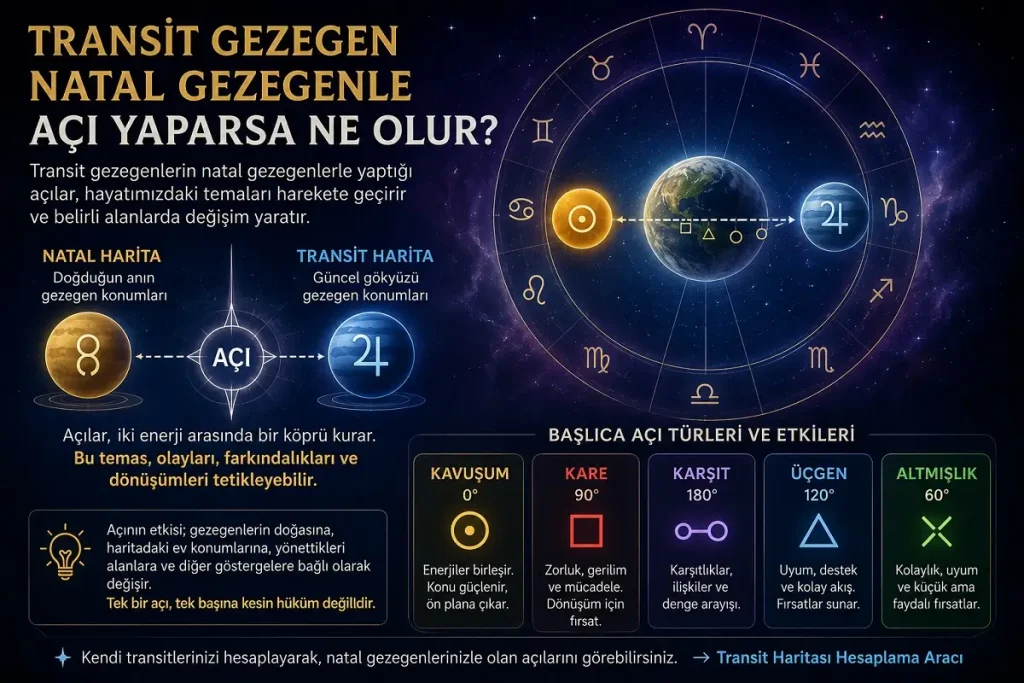
If a transiting planet makes an aspect with a natal planet The current planetary movement in the sky makes contact with a planet in the birth chart. This contact can bring to the forefront, for a certain period of time, the themes represented by that natal planet in the person's life.
for example When transiting Saturn makes an aspect with natal Venus Issues such as relationships, values, love language, financial security, or commitment can be addressed more seriously. Transiting Jupiter When it forms a harmonious aspect with the natal Sun, self-confidence, growth, visibility, and the desire to seize opportunities can increase.
However, this situation It is not a definitive indicator of an event on its own. How a transit aspect works depends on the type of aspect, the speed of the transiting planet, the strength of the natal planet in the chart, which houses it rules, and what other indicators are active during the same period. The same transit might bring up relationship decisions for one person, while for another it might manifest as money, family, work, or inner questioning.
Therefore, when interpreting transit aspects, simply asking "which planet made an aspect to which planet?" is insufficient. For a more accurate assessment, it is necessary to consider the house the transiting planet is passing through, the house the natal planet is in, and the overall structure of the chart.
To see current transits and aspects on your own chart: Transit Map Calculation You can use your vehicle.
Does Transit Angle Always Indicate Event?
Transit angles Often, it can create a sense of dynamism, awareness, decision-making, or internal pressure in certain areas of life. However... Not every transit angle signifies a major event in the outside world. Sometimes the effect manifests itself in a person's way of thinking, emotional responses, expectations, or perspective on matters they previously postponed.
for example When transit Mars forms a square aspect with natal Mercury A person might speak faster, make hasty decisions, or get into arguments more easily. This doesn't always mean a serious crisis. However, if Mercury is ruling the person's houses related to work, lawsuits, contracts, or siblings during the same period, the issue may become more apparent.
Similarly When transiting Neptune makes an aspect with the natal Moon Emotional uncertainty, sensitivity, or withdrawal may increase. This effect can sometimes manifest in family relationships, sometimes in spiritual depth work, and sometimes as difficulty clarifying one's feelings. The transit angle indicates potential; the entire chart determines the form of the event.
To discuss this topic in more detail. Do transits really bring about events? You can also take a look at the article.
Which Transit Angles Are Felt More Prominent?
The effect of transit aspects varies depending on both the type of aspect and the nature of the transiting planet. Conjunction, square, and opposition angles are generally more noticeably apparent. Because these angles can activate the established order more strongly.
Conjunction angle It gathers two energies at the same point. When a transiting planet over a natal planet, the subject matter of that natal planet intensifies. Transiting Uranus in conjunction with the natal Sun. This can increase a person's need for liberation in their sense of identity. This can sometimes manifest as a desire to change jobs, sometimes as a desire to distance oneself from one's environment, and sometimes as a feeling of "I don't want to continue like this anymore."
square angle It describes situations that require more friction, effort, and change of direction. Transiting Saturn squares natal Mars. When this happens, a person may want to move forward but may feel obstacles, responsibilities, or time pressure. When used correctly, this effect can provide an opportunity to discipline scattered energy.
opposite angle On the other hand, it can bring awareness through the outside world, relationships, and the other party. Transit Pluto opposition to natal Venus. This can lead to a profound questioning of power dynamics, commitment, boundaries, and the sense of value in relationships. This doesn't mean a definitive separation or a definitive reconciliation; it means a more raw and visible examination of relationship dynamics.
Triangle ve sexagesimal Aspects, however, work in a more supportive way. But even supportive aspects need to be evaluated. Because easily flowing energy sometimes provides opportunities, but sometimes, if the person doesn't take action, it only remains as inner relief. angles For detailed information Astrology Angels You can look at the link.
What to look for in transit aspect interpretation?
When a transiting planet makes an aspect with a natal planet, the first thing to look for is... which planets are making contact Transiting planets represent the external influences, while natal planets represent the life area and psychological themes that a person is born with.
for example If transit Jupiter is making an aspect with natal Mercury Mental expansion, education, travel, writing, speaking, business, or application processes may come to the forefront. However, the focus will shift to the areas ruled by the houses in the person's natal chart. If Mercury is connected to the 3rd and 6th houses, work routines, documents, communication, siblings, or daily plans may take center stage.
The following points are particularly important in interpreting transit aspects:
• transit speed of the planet,
• type of angle,
• the house in which the natal planet is located,
• Houses ruled by the natal planet,
• orb value,
• whether the angle is approaching or receding,
• other in the same period transit, progress or Solar Arc indicators.
Therefore, to get an accurate interpretation, you need to look at your personal chart. To see the current aspects in your own chart... Transit Map Calculation You can use your vehicle.
When do transit aspects become effective?
Transit aspects are generally felt as the planet approaches the natal planet, become pronounced at the exact time of the aspect, and gradually diminish as it moves away. However, this timeframe is not the same for every planet. While the effects of fast-moving planets like the Moon and Mercury are short-lived, the effects of heavier planets like Saturn, Uranus, Neptune, and Pluto can last longer.
for example When the transiting Moon forms a square aspect with natal Mars A few hours of tension, haste, or emotional reaction may be observed. However When transiting Saturn squares natal Mars This effect can work on your sense of responsibility, patience, energy management, and coping skills for months to come.
Retro Movements can also prolong the process. A planet first makes an approaching aspect with the natal planet, then returns due to retrograde motion and comes back to the same point, then completes the final contact with direct motion. During such periods, the same issue is addressed in several stages. The first contact reveals a point that was missing in the past, the second contact shows the missing point, and the final contact can allow for a clearer evaluation of the issue.
Therefore, the answer to the question "when does the transit aspect end?" cannot be given solely by looking at the degree. The planet's speed, whether it is retrograde, and which area of the natal chart it is triggering must be considered together.
general evaluation
When a transiting planet makes an aspect with a natal planet, a specific theme in the person's birth chart comes into contact with the current celestial movement. This contact can manifest as an event, a decision, an awareness, or an inner preparation. The healthiest approach is to avoid attaching too much meaning to a single aspect. It involves considering the type of aspect, the nature of the planets, house connections, and timing together. .
Frequently Asked Questions
The aspects that transiting planets make with natal planets are one of the most frequently inquired-about areas of astrological interpretation. This is because individuals often try to understand their charts by asking questions like, "What will this aspect initiate for me?", "Will it bring about an event?", "How long will it last?", or "Which aspect is stronger?". The answers, rather than providing definitive conclusions, indicate possibilities based on the overall chart.
What happens when a transiting planet conjuncts a natal planet?
Conjunctions reinforce and highlight the theme represented by the natal planet. Transiting planets add their own influence to that area. For example, a transiting Jupiter conjunction with the natal Sun can increase self-confidence and the desire for growth, while a transiting Saturn conjunction with the natal Sun can make responsibilities feel more serious.
Is Transit Square Angle a Bad Thing?
Transit frame rate isn't bad, however the need for effort, tension and regulation It can indicate that a person may find it difficult to continue in the same way and may need to develop a new attitude. When used correctly, square aspects can be periods of significant awareness and empowerment.
Does Transit Affect Oppositional Aspect Relationships?
Oppositions often relate to the outside world, relationships, partnerships, and the opposing side. However, not every opposition signifies a relationship problem. What matters is which natal planet is affected and which houses that planet rules in the chart.
Does a Transit Trine Aspect Always Bring Good Luck?
A trine aspect can indicate a supportive flow; however, taking action is crucial. A transiting Jupiter trine can give a sense of opportunity, but the realization of this opportunity depends on other indicators in the chart and the individual's choices.
How many days does the transit aspect effect last?
The influence of fast-moving planets can last from a few hours to a few days. Mars' influence can last for weeks. However, aspects between slower planets like Saturn, Uranus, Neptune, and Pluto and natal planets can be felt for months, and if retrograde motion is present, the same issue may resurface several times.
Does every transit aspect affect everyone in the same way?
No. Transit effects do not produce the same result in everyone. The house it falls into in the natal chart, whether it forms aspects with personal planets, the areas ruled by the natal planet, and other indicators from the same period should all be considered together.


WRITE A COMMENT
VISITOR COMMENTS - 0 COMMENTS