What are Transits? Planetary Transits in a Natal Chart
Subject Content
How are planetary transits interpreted in a natal chart?
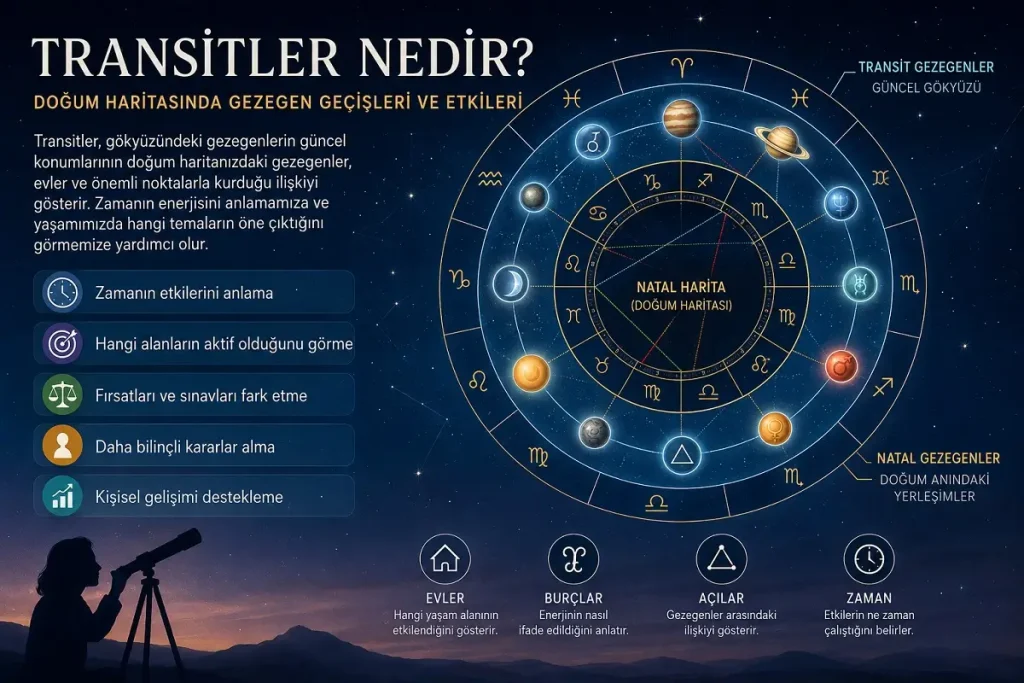
What are transits? In astrology, transits describe the relationship between the current positions of planets in the sky and the planets, houses, and points in a birth chart. While the birth chart reveals a person's core potential, transits show when this potential might become more apparent, which issues might come to the forefront, and in which areas of life a person might gain greater awareness.
A transit alone doesn't mean "this will definitely happen." For example... Saturn A transit through a house can heighten themes of responsibility, order, boundaries, and maturity; however, how this manifests as work, family, relationships, health, re__cpLocation, or inner awareness depends on the individual's birth chart. The same transit might increase workload for one person, while for another it could manifest as a need to tidy up their home.
The most important point in transit interpretation This includes which house the planet is transiting, what aspects it forms with natal planets, and what other indicators are active during the same period. Therefore, transits should be evaluated not only with zodiac interpretations but also in conjunction with the complete birth chart.
A fixed birth chart, also called a natal birth chart, reflects the general state of our condition at the moment of our birth. Essentially, we can see which characteristics we possess by looking at this chart. However, to see what astrological influences we will receive now and in the future, we need to look at the transit chart. This allows us to foresee astrological influences that haven't yet affected us and prepare ourselves accordingly. Transit Map Calculation With this tool, you can see the current and future effects you will experience, along with their angles and impacts on you.
What does Transit mean in astrology?
Transit in astrology A birth chart expresses the influence of the current movements of planets in the sky on the birth chart. A birth chart is fixed; it's like a symbolic photograph of the sky at the moment of a person's birth. Transits, however, are constantly changing. Therefore, a transit chart is used to understand which planetary influences a person is under on a particular date.
For example, in the natal chart Venus in Taurus Someone experiencing Mars transiting Taurus may find themselves in a more dynamic period in relationships, self-worth, finances, or physical motivation. However, this dynamism doesn't always mean significant events. Sometimes it might simply manifest as inner restlessness, a desire to make decisions, increased effort, or a repressed issue coming to the surface.
Transit is the way the sky touches your personal astrological chart. This connection can sometimes be seen as a short-lived mood, sometimes as a decision-making process lasting a few weeks, and sometimes as a strong life orientation that spans years.
What is a Transit Map?
Transit map This is a chart that examines a person's birth chart together with their current celestial positions. It is most commonly used within the inner circle. natal chartThe outer circle contains the transiting planets. This allows us to see which houses the current planets fall into in the birth chart and which planets they form aspects with.
In a transit chart, simply asking "which sign is the planet in?" is not sufficient. For a more accurate assessment, the following questions are considered together:
- Which house is the transiting planet passing through in the birth chart?
- Which planets does your natal chart form conjunctions, squares, oppositions, trines, or sextiles with?
- Is the transiting planet moving fast or slow?
- Is there a retro movement?
- Are there any other powerful transits, New Moon, Full Moon, or eclipse effects during the same period?
Therefore, those who wish to make a personal assessment should first Transit Map Calculation With this tool, you can see which areas of your birth chart are currently aligned with the sky.
What do transits show in a natal chart?
Transits, It shows which themes may come to the forefront in a person's life over time. These themes may sometimes be linked to external events, sometimes to inner awareness, and sometimes to decision-making processes.
for example transit Jupiter 2. passing through the house A person may focus more on issues such as money, skills, income streams, possessions, and self-confidence. This doesn't always mean a huge increase in wealth. Sometimes, a person confronts questions like, "What do I deserve?", "Which of my skills can I utilize better?", and "How can I strengthen my financial security?"
Transit of Saturn through the 7nd house Relationships, marriage, partnerships, and agreements may be taken more seriously. This period doesn't end every relationship; however, it may create a need to make realistic decisions in relationships that are unstable, have unclear boundaries, or lack a balanced sense of responsibility.
Transits often bring awareness before the event. The person begins to think and feel about the same issue, and to seriously consider a decision they had been postponing. Therefore, it is healthier to interpret transits not only with the question of "what will happen?" but also with the question of "what do I need to become more aware of?".
Why are Houses, Signs, and Aspects Important in Transits?
To understand the effect of a transit, three main elements are considered together: house, sign and aspect The interpretation may be incomplete if these three are not considered together.
House, It shows in which area of life the transit will affect. For example... 4th house The tenth house is connected to family, home, roots, and inner security. It also deals with career, public image, responsibilities, and goals. The themes of a particular house may become more prominent when a transiting planet passes through that house.
The zodiac sign describes how the transit will work. Mars in Aries might give a faster, bolder, and more direct urge to act, while Mars in Taurus might indicate a more patient but resilient effort. Therefore, "Mars transit" provides general information, but the question "In which sign and house is Mars?" personalizes the interpretation.
angles This shows how the transiting planet interacts with the planets in the birth chart. Conjunction indicates a strong emphasis, square indicates tension and a need for action, opposition indicates confrontation, trine indicates more fluid support, and sextile indicates opportunities that can be beneficial if evaluated. To see the aspects more clearly... Birth Chart Aspects and Placements You can use your vehicle.
Which planetary transits have a longer-lasting effect?
The speed of a planet is very important in transits. Fast-moving planets produce short-term effects, while slow-moving planets indicate longer-lasting periods.
Moon transits It's very fast-paced. It's related to emotional fluctuations, daily mood swings, short-term sensitivities, and instantaneous reactions. Sun transits It creates a seasonal emphasis that lasts approximately one month. Mercury, Venus ve Mars Transits can have effects, measurable over weeks, in areas such as communication, relationships, movement, decision-making, and motivation.
Jupiter and Saturn transits It creates more pronounced seasonal effects. Jupiter It's about growth, expansion, recognizing opportunities, and the search for meaning. Saturn It emphasizes themes of structure, responsibility, boundaries, discipline, and maturity.
Uranus, Neptune ve Pluto Transits work more slowly. When these planets make strong contact with personal planets or angular points in the chart, they can initiate processes that leave deeper, longer-lasting, and more permanent marks on a person's life. However, these effects are not limited to a single event; they often manifest as a process of awareness, resolution, change, or transformation that unfolds over years.
How long does the transit effect last?
The duration of the transit effect varies depending on the planet's speed, retrograde motion, the aspects it makes, and the point of contact in the birth chart. The shortest effects occur during lunar transits. The longest-lasting effects are... Uranus, Neptune ve Pluto This is seen during intense planetary transits, such as those mentioned.
Lunar transits are usually felt within hours or a few days. Sun Stone A transit through a house can create themes lasting about a month. Mercury and Venus can bring mental, relational, or social agendas lasting several weeks. Mars transits can feel more dynamic and pronounced; sometimes lasting a few weeks, and even longer during retrograde periods.
Jupiter stays in a sign for about a year; however, the aspects it makes to a specific degree in a personal chart become prominent for more limited periods. Saturn stays in a sign for about two and a half years and can trigger the same degree several times through retrograde motion. Uranus, Neptune, and Pluto, on the other hand, are active for much longer periods.
Therefore, there is no single answer to the question "how long does transit take?". As the planet slows down and returns to the same degree through retrograde motion, the effect can become longer and more instructive.
Do transits necessarily bring about events?
Transits It doesn't always bring about definite events. When a transit touches a strong point in the chart, it can pave the way for significant developments in the outside world; however, more often it is first felt as inner awareness, a shift in emotions, pressure to make decisions, or a need to reassess one's life structure.
for example transit Saturn If it affects one's career, this period can bring increased responsibility. However, this doesn't always mean job loss, promotion, or a change of role. Some people start working more disciplined, some organize their workload, and some redefine their professional goals realistically.
Transiting Uranus When this touches the realm of intimacy, some individuals may feel a greater need for freedom. However, this doesn't necessarily end every relationship. In strong relationships, new avenues can open up, the relationship can become more flexible, or the partners may begin to better understand each other's individual needs.
Transits indicate possibilities, themes, and the nature of time; they do not provide definitive results. For an accurate interpretation, the natal chart, transit house placement, aspects, other indicators from the same period, and the person's current life circumstances should be considered together.
How to Calculate Transit Maps?
To calculate the transit map. You will need your date of birth, time of birth, place of birth, your current location, and the date you wish to analyze. The time of birth is especially important for house placements. If the time of birth is unknown, the positions of the planets in the signs and some aspects can be seen; however, it may not be clear which house the transits are passing through.
When preparing a transit chart, the natal chart is drawn first. Then, the current planetary positions on the selected date are overlaid on the natal chart. This allows us to understand which houses the transiting planets are passing through and which aspects they are forming with the natal planets.
If the birth chart hasn't been created yet, first... Natal Chart Calculation The basic placements can be seen using this tool. Then, the transit map can be used to examine how the current sky interacts with the personal chart.
Transit calculation Focusing on only one planet during this process can sometimes be misleading. For example... Mars while bringing about short-term mobility during the same period Saturn It may indicate a longer-term area of responsibility. Jupiter while increasing opportunities Neptune This can increase feelings of uncertainty about the same issue. Therefore, the transit chart should be read as a holistic picture rather than focusing on a single planet.
In what order are planetary transits studied?
Planetary transits When examining planets, it's healthier to first look at the overall picture, then at personal interactions. Not all planets operate with equal weight. Some describe daily moods, some agendas for a few weeks, and others developmental processes spanning years.
• Moon, It reflects daily emotional fluctuations and short-term sensitivities.
• Sun, It describes which habitats might be more visible over the course of a month.
• Mercury, It highlights thought, speech, correspondence, education, commerce, and decision-making processes.
• Venus Relationships can affect the areas of aesthetics, money, and values.
• Mars It is related to movement, struggle, courage, anger management, and physical energy.
• Jupiter, It shows areas of growth and expansion.
• Saturn It highlights issues that require responsibility, boundaries, seriousness, and structure.
• Uranus It describes change, liberation, and unexpected shifts.
• Neptune It is associated with dissolution, uncertainty, ideals, intuition, and studies of spiritual depth.
• Pluto This can bring up themes of power, control, crisis management, letting go, and profound transformation.
This order makes transits more understandable. Daily influences are followed more by fast-moving planets, while long-term life themes are followed more by slower planets.
general evaluation
Transits are one of the most important indicators used in astrology to understand the nature of time. While the birth chart describes a person's core potential, transits show when this potential might become more apparent. Therefore, interpreting transits solely through the lens of "what will happen?" is incomplete. A more accurate question is: What issues are coming to the forefront, and what needs to be managed more consciously during this period?
Short-term transits can be related to daily mood, decisions, and temporary agendas. Longer-term transits, however, may create a need for more lasting change, maturation, a shift in direction, or a deeper understanding in one's life. In any case, the natal chart, transit house placement, planetary aspects, and other indicators during the same period should be considered together.
Transits are not used to make definitive predictions about fate, but rather to read time more consciously. Seeing which areas are active on your personal astrological chart allows you to make decisions more calmly, realistically, and consciously.
Frequently Asked Questions
The most frequently asked questions about transits usually concern how long the effect lasts, how to calculate it, whether it will produce the same result for everyone, and which planets are more powerful. To properly understand transits, it's necessary to look not only at the planet's sign but also at the houses, aspects, and connections it forms with personal planets in the birth chart.
What are transits?
Transits are the relationships that planets in the current sky form with the planets, houses, and points in a birth chart. They indicate which themes a person may encounter more frequently during a particular period.
What is a Transit Map?
A transit chart is a chart that examines the birth chart along with the current planetary positions. This chart reveals which houses the current planets are transiting in the personal chart and the aspects they are forming.
Do transits affect everyone the same way?
No. The same transit doesn't produce the same result for everyone. For the effect to become personalized, the house placements in the birth chart, the degrees and aspects of the planets, and the person's current life circumstances must all be considered together.
How long does the transit effect last?
The duration of a transit's effect varies depending on the planet. Lunar transits are short-lived; Jupiter and Saturn transits represent longer periods. Uranus, Neptune, and Pluto transits, on the other hand, can indicate deeper processes spanning years.
Which are the most powerful transits?
Generally, strong aspects that heavier planets—Saturn, Uranus, Neptune, and Pluto—make with personal planets or angular points have a more pronounced effect. However, faster planets can also trigger important dates.
Do Transits Bring Events?
Transits can sometimes pave the way for external events; however, not every transit necessarily brings about a specific event. Often, they are first felt as a period of increased awareness, emotional shifts, a need to make decisions, or a review of one's life routine.
Is the time of birth necessary for transit calculation?
Birth time is especially important for determining house placements. If the birth time is unknown, the positions of the planets in the signs and some aspects can be interpreted; however, it may not be clear which house the transits are passing through.