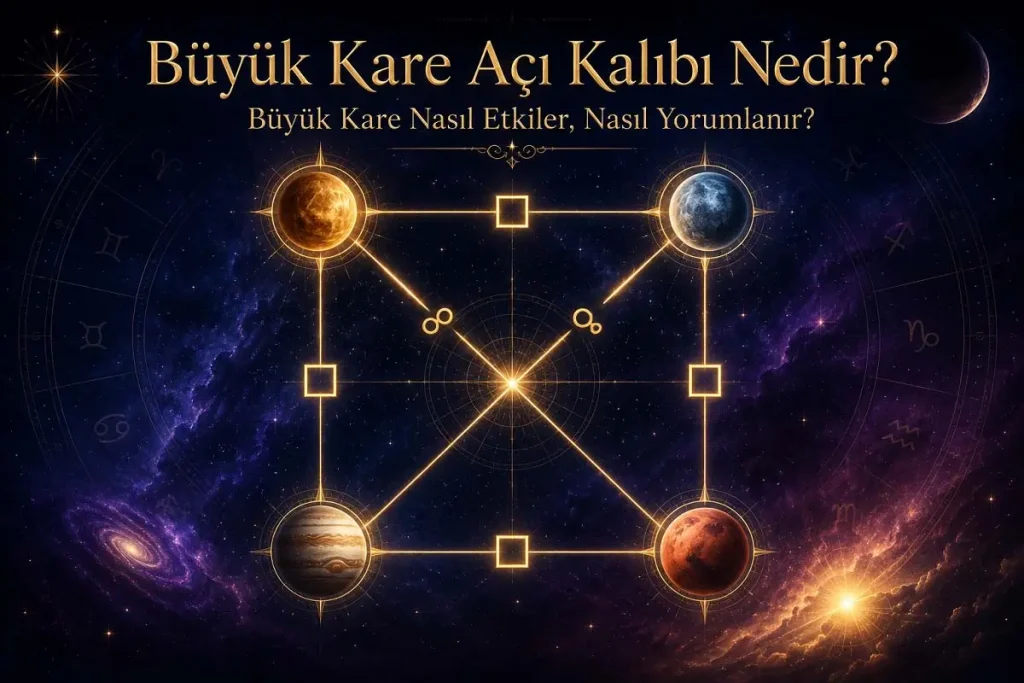
What is Kite Angle Pattern? How does it affect kites, and how can it be interpreted?
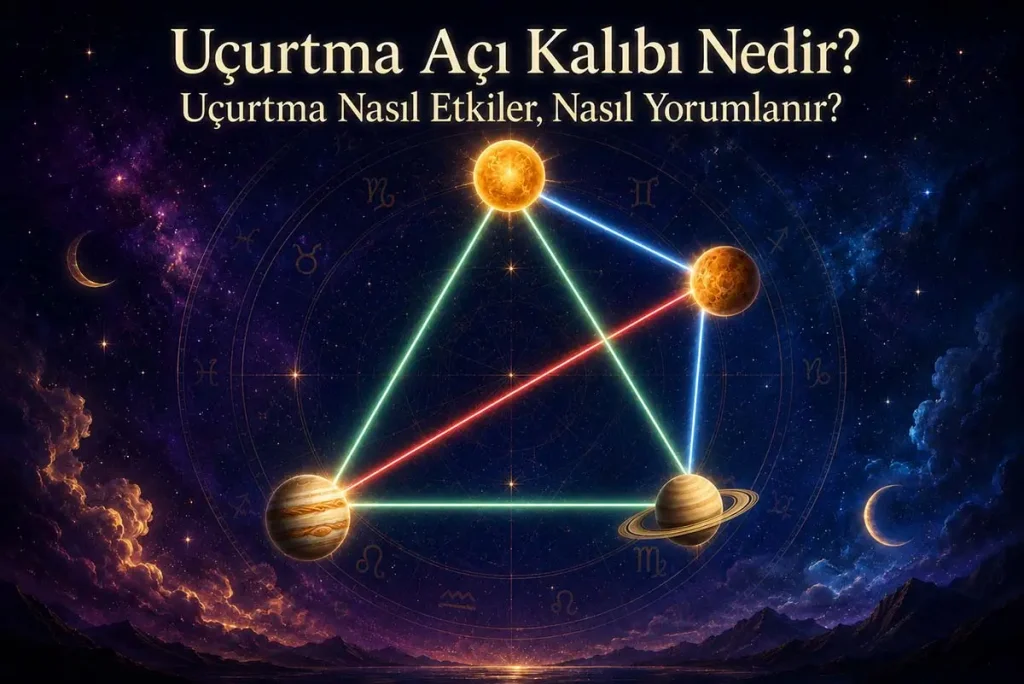
Subject Content
What does the Kite aspect pattern indicate in a birth chart?
The Kite aspect pattern in a birth chart shows that natural potential doesn't remain merely an inner comfort, but is instead connected to a specific goal, an axis of opposition, and a usable direction in the external world.
Kite angle pattern , astrology aspect patterns It stands out with its fluid and guiding structure. At the heart of this pattern is a Large Triangle Angle Pattern It is found in the Grand Triangle. The Grand Triangle can give a person natural flow, support, ability, and easily utilized potential. However, in the Kite, an axis of opposition is added to this easy flow. This opposition makes the pattern more active and goal-oriented.
The Grand Triangle, when used alone, can sometimes be too comfortable. A person might not realize their abilities, might not push themselves enough to develop their potential, or might consider an easy area to be ordinary. The Kite aspect pattern, however, adds an external call to action. The opposing aspect tells the person, "Use this potential." Therefore, the Kite can be thought of as a more conscious, more directed, and more functional version of the Grand Triangle.
It's really possible to liken this pattern to a kite. Grand Triangle It is like the fuselage of the kite; it provides support, balance, and form. Axis of opposition It works like the string of a kite. A kite glides in the sky, but without a string, it struggles to maintain its direction. Similarly, if there is a Kite in the birth chart, the person may have to use their natural talents more visibly through a specific goal, person, relationship, profession, task, or area of life.
Kite angle pattern usually to the person unleashing potential It provides a need. This structure is neither solely a pattern of chance nor solely a pattern of tension. It contains both a supportive and a stimulating axis. The individual has a natural flow in a certain area; however, the opposition reminds them not to leave this flow passive. Therefore, the Kite pattern is interpreted as a special structure that easily bridges the gap between goals on the map.
For example, in a chart with a Grand Trine in the water element, if the opposition axis is affecting the 10th or 4th house, the individual may need to utilize their emotional depth, intuition, and empathy in areas such as family, career, public image, or internal security. An opposition added to an Earth Grand Trine may require the individual to more actively utilize their practical skills in matters of work, finances, production, or tangible goals.
The most important message of the Kite aspect pattern is this: the support on the map needs to be used. The natural flow offered by the Grand Triangle is brought to life more visibly thanks to the axis of opposition. When used consciously, this pattern provides a person with a strong sense of direction, the ability to focus on goals, and the opportunity to utilize their natural potential in the outside world.
To find out if your birth chart has aspect patterns and, if so, which aspect patterns are present... Birth chart aspects and placements or Natal chart calculation You can use the tools. If you have a kite angle pattern, you can find the trigger dates and effects during transit. Transit Calculation You can learn it through the tool.
How is a kite's angle pattern formed?
The Kite aspect pattern is formed by adding a fourth planet to the Grand Trine; this planet forms an opposition to one of the Grand Trine's planets while forming a sextile aspect to the other two.
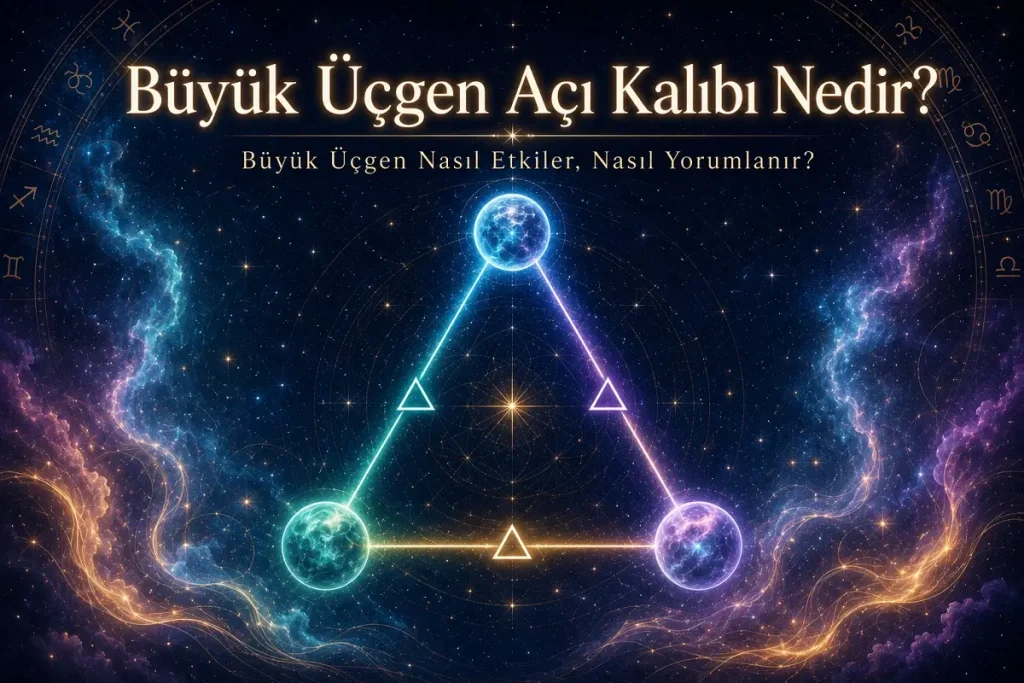
To understand the kite angle pattern, you first need to know about the Grand Triangle. The Grand Triangle is a triangle formed by three planets aligned with each other. triangle angle It is formed by this. This triangular structure provides a natural flow on the map. In the Kite, however, a fourth planet is added to this structure. This fourth planet is one of the planets of the Great Triangle. opposite angle does and with the other two planets sextile angle establishes.
Thus, the pattern ceases to be merely a closed triangle. A directional axis is formed on the chart. One corner of the Grand Triangle is stimulated by opposition; the fourth planet acts as the active point of the pattern opening to the outside world. Therefore, the Kite is considered a structure as relaxed as the Grand Triangle, but more dynamic.
Technically, the Kite website has the following connections:
• three triangular angles,
• two sextile angles,
• one opposite angle,
• A closed and directional pattern with four planets.
In this pattern, the axis of opposition is crucial because it determines the direction of the Kite. The Grand Triangle provides a supportive foundation, but the axis of opposition shows where that support should be moved. If the opposition isn't consciously managed, the individual might cling to the comfortable flow while simultaneously facing the call of the outside world, leading to indecision between the two.
In the kite pattern, two main points are usually carefully examined. First, the planet in opposition to the Grand Trine. This planet represents a strong point of awareness within the pattern. Second, the fourth planet in opposition to this one. This fourth planet can be the element that activates the potential of the Grand Trine and directs it towards a specific goal.
For example, if there is a Grand Water Trine between the Moon, Venus, and Neptune, and Mars is in opposition to one of these planets and in a sextile to the other two, the individual may have to use their capacity for emotion, intuition, and connection in the realm of courage, action, setting boundaries, or struggle, which Mars represents. Here, Mars acts not as a disruptive external factor, but as an active trigger that awakens potential.
When calculating the kite angle pattern, the orb value must also be carefully considered. The triangular angles of the Great Triangle should be strong, the opposition axis should be clearly defined, and the sextile angles should truly connect the pattern. Structures built with very large orbs may visually resemble a kite, but their effect may be weak.
When evaluating this pattern, the following questions should be asked:
• Which element is used to form the Great Triangle?
• In which sign and house is the fourth planet?
• Which two areas of life has this contrast connected?
• How do sextile angles support potential?
• From which planet does the mold open to the outside world?
• When do transits trigger the axis of opposition?
Kite, It's a technically recognizable pattern, but one that requires deep interpretation. This is because it contains both flow and tension. The key is to see how these two structures complement each other.
What is the difference between the Big Triangle and a kite?
While the Big Triangle provides natural flow and internal support, the Kite directs this flow towards the goal with an opposing axis; therefore, the Kite can operate more actively, more outwardly, and more results-oriented.
The Grand Trine and the Kite appear to be two very similar structures; however, there is an important difference between them. The Grand Trine forms a closed and fluid system among three planets. Energy flows freely within it. One may feel natural support in certain areas. However, this support can sometimes be passive. In the Kite, on the other hand, opposition is added to this closed structure, and the pattern establishes a stronger connection with the outside world.
The Big Triangle is like an internal resource. The Kite, on the other hand, is this resource connected to a goal. The Big Triangle tells the person, "You are flowing comfortably in this area." The Kite conveys the message, "There is a direction you need to use this flow in." Therefore, the Kite pattern can reduce the risk of complacency and inertia, which are the shadow aspects of the Big Triangle.
For example, a person with a Grand Triangle in the air might possess natural abilities in communication, learning, and idea generation. However, if they don't utilize these abilities, their potential may remain at a purely intellectual level. If a Kite is formed by adding an opposing element to this Grand Triangle, the person may be compelled to express, write, teach, bring these ideas into the social sphere, or use them towards a specific goal. This makes the flow more visible.
While the Grand Triangle provides more inner peace, the Kite draws a person towards an axis. This axis can sometimes be a relationship, sometimes a career, sometimes family, sometimes education, and sometimes determining one's inner direction. Since the axis of opposition determines the direction of the pattern, in the Kite, not only the element but also the houses in which the opposition is formed are very important.
The difference between the Big Triangle and a kite can be summarized as follows:
• The Big Triangle provides support, and the Kite activates that support.
• The Big Triangle operates more inwardly, while the Kite is more open to the outside world.
• The Big Triangle can provide comfort, and the Kite can create a sense of purpose.
• The Big Triangle can remain passive, while the Kite demands movement through contrast.
• The Grand Triangle represents potential, and the Kite is the embodiment of that potential in a directed form.
Therefore, the Kite aspect pattern can be a very valuable structure on the chart. The individual possesses both a supportive inner resource and a life axis that encourages them to utilize this resource. However, the key here is not to view the opposition as a problem. In the Kite pattern, opposition is not a tension that disrupts the pattern, but rather the key that activates it.
In what areas is kite angle pattern effective?
The houses in which the kite angle pattern forms indicate in which area of life a person will transform their natural potential into a goal, and along which axis of opposition they will experience development.
To understand the effect of the Kite aspect pattern, it's necessary to look at the houses of the planets that form the pattern. This is because the element of the Grand Trine indicates the style of potential, while the houses show in which areas of life this potential will operate. The axis of opposition, on the other hand, describes between which two extremes the individual needs to develop awareness.
For example, if there is an Earth Grand Trine between the 2nd, 6th, and 10th houses, and a planet in opposition from the 4th house connects to this structure, the individual may possess strong practical potential in matters of earning money, work organization, and career. However, family, home life, or internal security may constantly force a balancing act on this potential. This person may be successful in their professional life; however, the flow can be disrupted if inner peace and family balance are not maintained.
3th house , 7th house ve 11th house If there is an air Grand Trine between them and an opposition from the 9th house, communication, relationships, and social circles can be strongly emphasized. However, the person's belief system, educational goals, connections to distant places, or worldview may want to connect this communication network to a larger meaning. This type of Kite can be effective in areas such as teaching, writing, consulting, social influence, or knowledge sharing.
4th house , 8th house ve 12th house If there is a Grand Water Trine between them and an opposition from the 10th house, the person is strong in the areas of emotional depth, intuition, and inner analysis. However, career, public position, or visibility may call them out to the outside world. In this case, the person may learn to utilize their inner depth in a professional field.
1th house , 5th house ve 9th house If there is a Grand Trine of Fire between them and a planet in opposition from the 7th house, the person may possess a powerful energy in terms of self-awareness, self-expression, and worldview. However, relationships and partnerships require balancing this energy. The individual must learn how to cooperate with others while forging their own path.
Kite angle patterns can be particularly effective in the following areas:
• career and goal setting,
• relationships and partnerships,
• education, communication and social environment,
• earning money and production,
• family order and internal security,
• artistic expression and stage performance,
• Spiritual deepening exercises and inner journeying.
In this pattern, the axis of opposition usually indicates the area that initiates growth. While a person may want to be content with the comfort provided by the Grand Triangle, the opposition speaks to them from another end. This voice may come in the form of a partner, a career opportunity, a family responsibility, or an inner restlessness. But ultimately, it carries the same message: Use your potential.
How does the Kite Angle Pattern work in transits?
When transits trigger the Kite aspect pattern, the natural supports present in a person's birth chart become more targeted; opportunities, decisions, and awareness can become more prominent through the opposition axis.
If there is a Kite angle pattern on the natal chart This structure operates as a potential throughout life. However, the Kite pattern becomes more visible when transits touch key points in the pattern. Transits, especially those hitting the opposition axis, can accentuate the pattern's direction and its impact on the outside world.
Transiting Jupiter When the kite pattern is triggered, a person may find opportunities to expand their potential. Support may come in areas such as education, work, travel, promotion, social circles, or personal development. However, Jupiter can sometimes bring exaggeration. If a person amplifies the easily flowing energy too much, they may lose balance.
Transit Saturn When the Kite pattern is triggered, it may be time to materialize its potential. Saturn may not feel supportive because it demands responsibility. However, structure, discipline, and long-term planning are necessary for the Kite pattern to function without falling apart. Therefore, Saturn transits can help to more firmly establish the Kite pattern in life.
Transiting Uranus When this opposing axis is triggered, unexpected developments, changes of direction, or a need for liberation may arise. The individual may begin to utilize their natural potential in a different area. Transit Neptune When it occurs, inspiration, intuition, and sensitivity may increase; however, the sense of purpose may become blurred. Transit Pluto This can initiate a deeper transformation process in the areas where the pattern is already in use.
During kite transits, the following questions are important:
• Which planet is the transit triggering?
• Which corner of the Great Triangle is activated?
• Is the axis of opposition working?
• How does the fourth planet trigger this pattern?
• Does transit offer opportunities or demand responsibilities?
• Which of a person's potentials should they now utilize in the outside world?
Significant insights can arise, especially when eclipses trigger the Kite pattern. When an eclipse coincides with an opposition axis, a person may encounter an issue in their life that requires direction-setting. This could be a relationship, work, family, or a long-awaited internal decision.
The triggering of the kite pattern by transits doesn't usually manifest solely as a crisis. Often, it can appear as a door opening, an opportunity appearing, a convergence of support, or a clearer utilization of one's natural abilities. However, for these opportunities to bear fruit, the individual must take action. The kite soars in the sky, but if the string isn't held, it can lose its way.
To track these periods Transit Map Calculation You can use this tool. First, the planets that make up your natal Kite should be determined, then the aspects that transits make, especially to the opposition axis and the fourth planet, should be monitored.
How to Calculate and Balance the Kite Angle Pattern?
To calculate the kite angle pattern, first the Grand Triangle structure is found, and then it is examined whether a fourth planet is connected to this triangle with opposition and sextile angles.
The first step in calculating the Kite pattern is to see if there is a Grand Trine in the birth chart. If three planets form a trine aspect to each other, a closed flow system is formed. Then, it is checked whether a fourth planet forms an opposition aspect to one of the vertices of this triangle. If the same planet forms a sextile aspect to the other two vertices, the Kite aspect pattern emerges.
For this technical review Birth Chart Aspects and Placements You can use the tool to see the general layouts of the map. Natal Chart Calculation The page will also be supportive.
The following steps can be followed when calculating a kite:
• The trine aspects in the birth chart are determined.
• The Great Triangle structure is checked,
• We check whether the fourth planet forms an opposition aspect with the other planet.
• It is examined whether the same planet makes a sextile angle with two other points,
• Determine in which houses the axis of opposition operates.
• The pattern element and transit triggers are evaluated.
Balancing the kite's shape It's about not passively allowing the smooth flow of the Grand Triangle to continue. One must recognize where ease lies, but connect that ease to goals in the external world. The pattern doesn't work properly if the axis of opposition is ignored, because it's this axis that determines the direction of the Kite.
To balance this pattern, the following approaches are important:
• recognizing natural talent,
• not ignoring the call on the axis of opposition,
• connecting potential to a concrete goal,
• not staying in your comfort zone,
• using support at the right time,
• Taking advantage of opportunities that come with transits.
Kite angle pattern When used intensely, it gives a person a strong sense of direction. The individual learns to utilize both their inner resources and the calling from the outside world. The flow of the Grand Triangle becomes highly effective when combined with an awareness of the opposing axis.
Frequently Asked Questions
The kite angle pattern is a special structure that connects the natural flow of the Great Triangle to the target via the axis of opposition. To understand this pattern, it is necessary to see how triangles, sextiles, and opposition angles work together.
What is a kite angle pattern?
The Kite-like aspect pattern is formed by adding a fourth planet to the Grand Trine. This fourth planet forms an opposition to one of the planets in the Grand Trine, while forming a sextile aspect to the other two. Thus, the natural flow is tied to a specific direction.
What does the kite's angle pattern indicate?
The kite in a birth chart represents the channeling of natural potential towards a goal. The individual possesses ease and support in a particular area; however, they need to utilize this potential in the external world. The opposing axis indicates the direction of development within the pattern.
What is the difference between a kite and the Great Triangle?
The Grand Triangle provides natural flow and inner support. The Kite, on the other hand, adds an axis of opposition to this flow, activating potential more effectively. While the Grand Triangle operates more internally, the Kite is more open to the outside world and goal-oriented.
Is the angle pattern of a kite lucky?
The kite is a supportive symbol; however, it shouldn't be interpreted solely as luck. It gives a person potential and direction. But for this potential to yield results, the person must consciously utilize the opposing axis and take action.
What are the angles that make up a kite?
The kite is formed by three triangular angles, two sextile angles, and one opposition angle. At its base is the Grand Triangle. The fourth planet forms an opposition angle to one vertex of the Grand Triangle and is connected to the other two vertices by sextile angles.
Why is contrast important in kite angle patterns?
The axis of opposition determines the direction of the pattern. The Grand Triangle provides support; the opposition shows where that support should be used. Ignoring the opposition can weaken the Kite's sense of purpose.
In what areas is the kite angle pattern effective?
It varies depending on the houses in which the planets forming the pattern are located. It can be influential in areas such as career, relationships, family, money, education, communication, social circle, or inner direction. The houses of the opposition axis are particularly important in the interpretation.
Do transits trigger the Kite angle pattern?
Yes, transits can trigger the natal Kite pattern. Transits that occur especially on the opposition axis make the pattern more visible. Jupiter can bring opportunity, Saturn structure, Uranus change, Neptune inspiration, and Pluto profound transformation.
What does the kite angle pattern mean in relationships?
In relationship charts, the Kite pattern can indicate a specific axis of growth between two people, along with a supportive flow. If this pattern is present in a synastry or composite chart, the relationship may have potential; however, issues on the opposing axis should be addressed consciously.
How do I know if there are kites on my map?
First, we look for a Grand Trine in your chart. Then, we examine whether a fourth planet forms an opposition aspect to one corner of this triangle and a sextile aspect to the other two corners. To do this... Birth Chart Aspects and Placements The vehicle is available.
WRITE A COMMENT
VISITOR COMMENTS - 0 COMMENTS