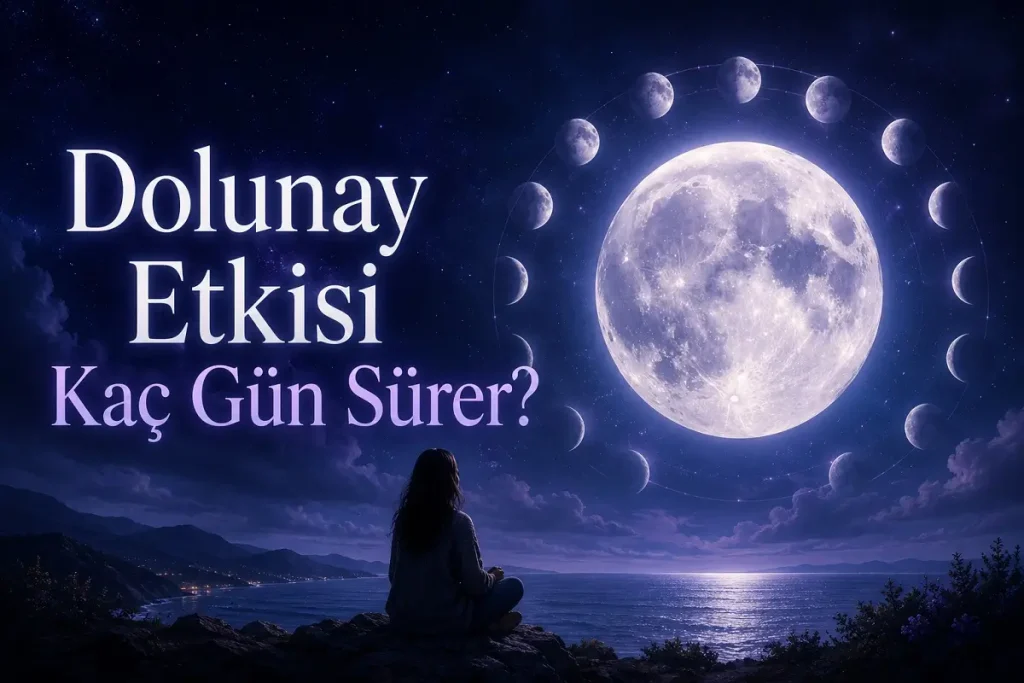
How long does the effect of the full moon last? Emotional and astrological duration.
Subject Content
When does the effect of the full moon begin and end?
How many days does the effect of the full moon last? Astrologically, the influence of the Full Moon usually starts around the Full Moon itself. It starts to be felt 2-3 days in advance. It becomes most noticeable during a full moon, and then... It will gradually decrease within 2-3 days. Therefore, the total duration of effect for an ordinary Full Moon is often... 5–7 days can be considered as. However, this timeframe is not the same for everyone. If the full moon touches a significant point in a person's birth chart, its effects can be felt more distinctly, and the issues raised may linger in thoughts, relationships, or decision-making processes for several weeks.
A full moon is the phase of the moon when the sun and moon are in opposite positions. Therefore, it is more commonly used in astrology. Completion, awareness, confrontation, outcome, and emotional visibility. It is connected to these themes. While the New Moon is mostly described as representing a new beginning, the Full Moon brings a matter to light. Hidden emotions, postponed conversations, growing unease, or decisions that need to be clarified may be perceived more clearly during Full Moon periods.
However, a Full Moon alone should not be interpreted as "guaranteed to bring an event." The strength of its influence varies depending on which house the Full Moon falls into in the birth chart, whether it forms aspects with personal planets, and whether there are other significant transits on the same days. To see which area of your life the Full Moon affects in your personal chart... Eclipse, Full Moon, New Moon Personal Calculator You can view your own map through this platform.
How many days before the full moon does its effect begin?
The effects of the full moon begin to be noticed by most people even before the actual full moon day. In particular, emotional sensitivity, changes in sleep patterns, inner restlessness, the recurrence of past issues, or increased attention to relationship matters are common signs of the full moon. 2-3 days ago may become evident.
This process is related to the Moon approaching its Full Moon phase in the sky. As moonlight increases, so does symbolic visibility. A person may become aware of an emotion they previously suppressed. For example, an issue they've long dismissed with phrases like, "I'm actually uncomfortable about this, but I shouldn't talk about it now," might create more internal pressure before the Full Moon. This doesn't always mean a major external event will occur; sometimes it's simply about a person seeing a truth more clearly within themselves.
The most important thing to pay attention to before the full moon is: It is important not to immediately translate emotional surges into decisions. Because full moon periods can bring awareness; however, it may be healthier to wait a few days for this awareness to mature. Especially in matters of relationships, work, family, and money, trying to understand the reality instead of reacting impulsively can yield more balanced results.
Why is the effect felt more strongly on a full moon day?
On the day of the full moon, Ay ve Sun Stone Because their opposition is definitively established, the effect can be perceived more intensely. In astrological symbolism, the Sun represents conscious will, while the Moon represents emotions, needs, and inner security. When these two lights are in opposition, the individual may have a particular issue... Reason and emotion, desire and need, external world and internal world You may feel a more pronounced tension between them.
Therefore, during Full Moon days, people can sometimes be more easily offended, want to speak more clearly, or find it difficult to hide pent-up emotions. For example, a comment that would normally be dismissed with a simple "it's nothing" might carry more weight during a Full Moon. This is because it's not just about the comment itself; perhaps a long-standing feeling of worthlessness, being overlooked, or misunderstood has become apparent through that comment.
Therefore, it is not correct to view every emotion experienced during Full Moon periods as an exaggeration. Sometimes the Full Moon illuminates an already existing truth in a brighter light. But similarly, It is also not correct to accept every intense emotion as absolute truth. Emotions run high during a full moon; assessments should be made more calmly a few days later.
When does the effect of the full moon diminish?
The effect gradually diminishes in the first 2-3 days after the full moon. However, this decrease doesn't always mean "the matter is completely over." More accurately, the emotional pressure of the full moon lessens; but the issue that has become visible may continue to be considered by the person for some time.
For example, if trust issues arise in a relationship during a Full Moon, the discussion may end three days after the Full Moon, but the person may carry the question, "Do I truly feel safe in this relationship?" for much longer. Or, if dissatisfaction is noticed in professional life, even after the Full Moon's influence passes, this awareness may transform into a need for a new arrangement.
The period after the full moon, especially Calm assessment and letting go of unnecessary burdens. It is valuable in this respect. What is seen during a full moon doesn't necessarily mean an immediate break, confrontation, or definitive decision. Sometimes it's simply an adjustment: setting clearer boundaries, honestly expressing feelings, completing a task, or reducing a habit that is no longer beneficial.
Does the full moon affect everyone the same way?
The full moon doesn't affect everyone with the same intensity. Some people feel full moon periods very strongly, while others may hardly notice them at all. The main reason for this is the individual's birth chart. If the full moon degree is in close contact with the person's Sun, Moon, Ascendant, MC, Venus, Mars, or other significant points in the chart, the effect can become more personal.
Especially the Full Moon in a person's birth chart
• Moon sign,
• Sun sign,
• to the rising degree,
• to their personal planets or
• important home beginnings
It might be more noticeable if it's at a close angle.
Here, simply knowing one's astrological sign isn't enough. For example, saying "The full moon was in Capricorn, and I'm a Capricorn" alone doesn't provide a definitive answer. The degree at which the full moon occurred, whether there are planets or points close to that degree in the person's chart, and which house it falls into are more important factors.
Therefore, instead of using phrases like "this zodiac sign will definitely be affected" in Full Moon interpretations, Personal map theme This should be taken into consideration. While the same Full Moon might bring work-related issues to the forefront for one person, for another it could raise concerns about family, relationships, health sensitivities, education, or inner peace.
Does the effect of a full moon last longer during a lunar eclipse?
Yes, lunar eclipses carry a full moon theme because they occur during a full moon; however, they are considered to last longer than a typical full moon. While a normal full moon usually creates an intense area of influence lasting 5-7 days, lunar eclipses have a stronger impact if they strongly affect a person's astrological chart. a process that spans weeks, or even months in some cases It can function as such.
It's not accurate to make definitive judgments here. Not every lunar eclipse causes major events in everyone's life. However, if the eclipse degree is in close contact with personal planets or significant points in the chart, the issue that becomes visible may bring a more lasting awareness. Themes related to relationships, family, career, life direction, relocation, completion, and closure may become more prominent.
Think of the difference between a full moon and a lunar eclipse like this: A full moon is like turning on a light in a room; you see something. A lunar eclipse, on the other hand, might cause you to examine the order in that room for a longer period. What will remain, what will change, what has lost its former function? Eclipses can bring these questions to the forefront more strongly.
What precautions should be taken during the full moon?
The most important thing during a full moon is to observe the heightened emotion without suppressing it, but also without immediately reacting. Because when the full moon brings an issue to the forefront, one may sometimes feel pressured to "resolve this immediately." However, the few days following the full moon offer a healthier period for reflection, allowing some issues to become clearer.
During this period, it may be particularly helpful to pay attention to the following:
• Postpone making hasty decisions for a few days,
• reduce accusatory language in emotional conversations,
• taking physical and mental fatigue into account,
• simplifying the tasks that need to be completed,
• To evaluate the apparent reality without exaggeration.
Sometimes a full moon makes the sentence inside a person more visible: "I can't carry this like I used to." This sentence doesn't have to mean an end. Sometimes it requires a more honest conversation, sometimes a clearer boundary, and sometimes it requires being more open with oneself. The most instructive aspect of a full moon is that it reveals what is hidden.
Frequently Asked Questions
Questions about the effects of the full moon generally focus on how long it lasts, when the effect begins, why it is felt more intensely in some people, and how it differs from lunar eclipses. These answers provide a general astrological framework; for individual effects, the house, degree, and aspect contacts in the birth chart should be evaluated separately.
How many days exactly does the effect of the full moon last?
The effect of the full moon is usually 5–7 days It lasts. It begins 2-3 days before the full moon, becomes most prominent at the time of the full moon, and diminishes over the next 2-3 days. However, the duration varies depending on the effect in individual charts. If it touches a significant point in the personal chart, the issue may remain on the agenda for a longer period.
How many days before the full moon's effects are felt?
Most people think the effect of the Full Moon is approximately 2-3 days ago They may begin to feel. During this process, emotional sensitivity, restlessness, awareness, a desire for completion, or topics that need to be discussed may become more prominent.
Does the effect disappear immediately after the full moon?
No, the effect doesn't end immediately after the Full Moon. Emotional intensity lessens in the first few days; however, the issues highlighted by the Full Moon can be evaluated, on a mental or life level, for some time longer.
Does the full moon affect everyone?
A full moon is a general celestial event; however, it doesn't affect everyone in the same way. Individuals with planets, ascendants, or significant house beginnings near the full moon degree in their birth chart may feel this effect more pronounced.
Can a full moon affect sleep?
Some people may experience changes in sleep patterns, increased mental activity, or emotional intensity during Full Moon periods. This is not true for everyone. The individual's Moon placement, sensitivities, and life circumstances during that time should be considered together.
Is it wise to make decisions during a full moon?
A full moon can bring increased awareness; however, making hasty decisions based on intense emotions isn't always healthy. Especially regarding relationships, work, family, and finances, waiting a few days and taking a calmer approach might be more balanced.
Does a lunar eclipse have a longer-lasting effect than a full moon?
Yes, even though a lunar eclipse occurs during a full moon, its effects are considered to be longer-lasting. If it strongly influences a personal chart, it can bring about awareness and completion processes that may remain relevant for weeks or months.


WRITE A COMMENT
VISITOR COMMENTS - 0 COMMENTS