What does Stellium mean on a chart?
Subject Content
What does a stellium indicate in a birth chart?
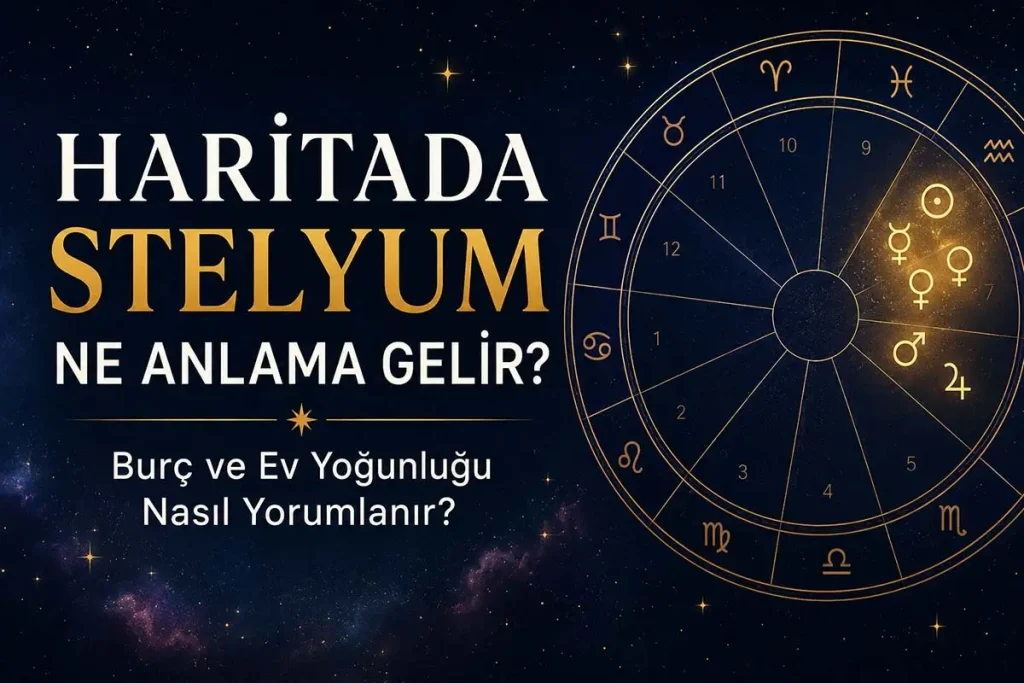
Stellium on the map This refers to the concentration of multiple planets in a particular sign, house, or narrow degree area. In modern astrology, it is often used. The conjunction of 3 or more planets stellium This is generally accepted. Some approaches, however, require four planets or that the planets be connected by a conjunction chain. Therefore, it is necessary to look not only at the number of planets but also at the degree distance between them.
The basic meaning of stellium is a specific theme in the chart. high intensity and strong focus The zodiac sign indicates how this energy is expressed, while the house shows in which area of life it is most visible. For example, a stellium in the 10th house might highlight career, social roles, and responsibilities. However, a stellium consisting of the Sun, Venus, and Jupiter is not interpreted in the same way as a stellium consisting of Mars, Saturn, and Pluto.
This placement doesn't automatically mean luck, success, or difficulty. A stellium is a concentration of great potential in one area; how this potential is used is determined by the qualities of the planets, their aspects, rulers, and the chart as a whole. Imagine all the lights on a stage are focused on a single point: that area is easily noticeable, but the surrounding areas may also need to be consciously supported.
To see stelliums on your chart Birth chart angle calculation, Natal chart calculation and to see how these are triggered in transits Transit map calculation you can use tools.
How many planets are needed to form a stellium?
While the number of planets is important, it is not the sole metric for determining true density.
According to the most common definition, those who are of the same zodiac sign or in the same house three or more planets They can form a stellium. However, not every three-planet arrangement is equally powerful. Since the Sun, Mercury, and Venus cannot stray very far from each other in the sky, it is relatively common for these three planets to be in the same sign. When another planet, such as Mars, Jupiter, or Saturn, joins the group, the intensity can increase.
Some astrologers prefer a stellium with four planets or three planets connected within a specific orb. A group of planets in the same sign, with the first and last planets separated by 25 degrees, may not function as cohesively as a narrow stellium, even though it shows a high concentration of signs.
The lunar nodes, Lilith, Chiron, and asteroids alone may not be considered the primary elements completing the planetary count. However, if positioned near a stellium of actual planets, they can add further meaning to the subject of density.
What is the difference between a zodiac stellium and a house stellium?
A zodiac stellium describes the form of energy expression, while a house stellium describes the area of life where the intensity of energy is directed.
When three or more planets are in a sign, the element, quality, and behavioral patterns of that sign become more pronounced. For example, a stellium in Scorpio can reinforce themes of deepening understanding, investigating hidden reasons, managing crises, and intensity in emotional relationships. If the planets are distributed between the 6th and 7th houses, the emphasis can be seen in both work routines and responsibilities, as well as relationships.
In a house stellium, planets can be in different signs. For example, if a planet is in Libra at the end of the 6th house, followed by two planets in Scorpio, then 6th house themes become prominent; however, the behavior of the planets will not be the same. The concentration of planets in one house can strongly emphasize that area of life, as can be seen in other house examples.
The concentrations on your map Birth Chart Aspects and Placements You can examine it with the tool. The zodiac sign answers the question of "how," the house the question of "where," and the planets the question of "what functions they perform."
How do planets in a stellium influence each other?
A stellium isn't a single energy; it's the collaboration of different planetary functions in the same field.
As planets draw closer together, their interaction intensifies. Two planets conjunct with the narrowest orb can illustrate the workings at the center of a stellium. The Sun represents identity and will, the Moon emotional needs, Mercury thinking and communication, Venus values and relationship dynamics, and Mars the drive for action.
For example, someone with a Mercury, Mars, and Saturn stellium in the 3rd house cannot simply be interpreted as "very talkative." Mercury can accelerate thoughts, while Mars can add boldness and sharpness to speech; Saturn, on the other hand, can bring a tendency to control words or fear of being misunderstood. The person might remain silent for a long time, but when they do speak, they might use a powerful expression that goes straight to the point.
If the Sun, Moon, or Ascendant ruler participates in the stellium, the intensity may be more personal and visible. If influenced by outer planets like Uranus, Neptune, and Pluto, the close contacts they form with personal planets are particularly significant.
Is Stellium Powerful or Challenging?
Intensity can both foster specialization and lead to excessive energy being devoted to the same subjects.
The strength of a stellium lies in its capacity for deep focus on a particular subject, accumulation of experience, and sustained concentration. However, when all attention is concentrated on a single point, perspective can narrow, or the individual may define themselves solely through the area where the stellium is located.
For example, a stellium in the 2nd house can constantly bring issues of financial security, personal resources, and self-worth to the forefront. A person might be successful in developing methods of earning income; however, if they measure their worth solely by their possessions, the intensity can become exhausting. The themes of sharing, trust, and common resources in the opposing 8th house can provide balance.
Similarly, a stellium in the 7th house can transform relationships into a significant area for growth. If a person makes all their decisions based on the other person's reaction, they may need to strengthen the 1st house's themes of individual will and personal boundaries. The opposite house is a complementary pole that balances the intensity of the stellium, not one that neutralizes it.
Does life focus solely on the area of the house where the stellium is located?
Stellium is an important center of gravity; however, it doesn't invalidate the rest of the map.
The themes of the house where the stellium is located may resurface repeatedly. However, it cannot be said that the person will only experience that specific area. The other houses ruled by the planets in the stellium shift the intensity to different parts of the chart. For example, if Venus in the 10th house rules the 2nd and 7th houses, career issues may be related to money, self-worth, relationships, and partnerships.
Stelliums in corner houses may be more visible. Stelliums in other houses are no less significant; their effects can manifest through learning, daily routines, inner world, or social goals.
Accurate determination of a house stellium requires a reliable birth time. If the planets are close to the house cusp, the house system used can alter the result. However, a zodiac stellium is generally less affected by the birth time.
How are stelliums triggered by transits?
Unless the stellium is a single degree, transit effects often develop in stages.
When a transiting planet makes aspects to planets in a stellium in turn, the same life theme can come to the forefront with different layers. For example, if Saturn first contacts natal Mercury, then Venus, and finally the Sun, the process may develop first regarding decisions and communication, then relationships and values, and finally identity and responsibilities.
Contacts with fast-moving planets can provide short-term activity. Contacts with slower-moving planets like Saturn, Uranus, Neptune, and Pluto can extend over a longer period. The type of aspect, the orb distance, and other indicators in the same period should be considered together. In transit interpretations, the house the planet is transiting and the aspects it forms with natal indicators should be examined together.
To understand the connections that make up a stellium angles in astrology and especially conjunction angle This is important. Being in the same zodiac sign doesn't mean all the planets are equally close to each other.
How to interpret a stellium in a chart?
A sound interpretation relies more on understanding how density works than on simply counting planets.
When examining a stellium, the following sequence can be used:
- The planets that make up the stellium are identified.
- It is checked whether they are of the same zodiac sign, the same house, or both.
- The closest conjunctions and degree ranges are found.
- The position and aspects of the ruling planet of the sign are examined.
- Connections are made with other houses ruled by the planets.
- External factors and periodic triggers are evaluated.
For example, someone with a Sun, Mercury, and Venus stellium in Capricorn and the 10th house might be inclined to express their identity, thoughts, and values through their professional goals. They may want to appear reliable at work and translate their knowledge into tangible results. If the ruler of the stellium, Saturn, is in the 4th house, career decisions may be linked to family responsibilities or the need for security. Saturn's aspects help to understand whether this process will proceed with pressure and fear of delay, or with patience and planning.
general evaluation
A stellium indicates a strongly emphasized area on the chart; it doesn't tell the whole story on its own.
The presence of a stellium in a chart indicates that the characteristics of a particular sign or the themes of a particular house may be experienced more intensely. This intensity can provide specialization, determination, and a strong sense of direction, but it can also bring a tendency towards overfocus or neglecting other needs.
The most accurate assessment; The nature of the planets, their degree proximity, the sign and house they are in, their ruling planet, the aspects they receive from external sources, and periodic triggers. This can be done when examined together. Astrological influences do not produce the same result in everyone. A person's choices, life circumstances, and other indicators in the chart change how this intense potential is used.
Frequently Asked Questions
The most frequently asked questions about stelliums concern the number of planets needed, whether the lunar nodes are taken into account, and how to differentiate between concentrations in the same house and sign. The answers below provide the basic distinctions; in a personal interpretation, the planetary degrees and the chart as a whole should be considered separately.
Do all three planets in the same zodiac sign count as a stellium?
According to the common approach, it can be counted; however, if the degree distance is very large, the arrangement may not function as strongly as a narrow and integrated stellium.
Does a conjunction of the Sun, Mercury, and Venus form a stellium?
Many modern approaches consider this a stellium. Because these three planets can move close together, the degree of proximity and whether another planet joins the group are considered.
Are the Lunar Nodes or Lilith included in a stellium?
The lunar nodes and Lilith are not planets. While they may not form a powerful stellium on their own when added to two planets, they can influence the theme if they are near an existing stellium.
Does a stellium indicate success or fame?
It doesn't show everything on its own. For success and visibility, the 10th house, MC, Sun, chart ruler, and periodic indicators should also be examined.
Can a stellium spread to two houses at once?
Yes. Planets in the same sign can lie on opposite sides of the house starting line. In this case, the shared sign theme is expressed in two different areas of life.
Are Transit Stellium and Natal Stellium the Same Thing?
No. A natal stellium is a permanent planetary alignment at the time of birth. A transit stellium, on the other hand, is a temporary concentration of planets in the sky.
Is it possible to find a stellium without knowing the time of birth?
A zodiac stellium can be found in most cases. Accurate birth time is necessary to reliably determine a house stellium.


WRITE A COMMENT
VISITOR COMMENTS - 0 COMMENTS