Quadrants in the Birth Chart – Their Effects on Life and Will
Updated: April 30, 2026 18:23 Scorpion
Subject Content
Quadrants in the Birth Chart – Their Effects on Life and Will
in the natal chart dials These are broad psychological frameworks that show which areas of life the planets are concentrated in. This distribution of energy, which can be read at first glance at a chart, is crucial for understanding how a person experiences life, what their motivations are, and what themes their will operates on. Often, a person's behavior, choices, and recurring life cycles are driven not by a conscious choice, but by the energy flow of the quadrants. The fundamental aspects of the chart, ASC–DSC ve MC–IC These four quadrants, formed by the combination of the axes, explain both the inner world of the person and his orientation towards the outer world at the same time.
Some people live life naturally “self-centered” experiences; their own wishes, their own decisions and individual goals are at the forefront. Some people change their direction in life relationships , partnerships and find it through people's reactions to them. Another group withdraws into their inner spaces and turns to a deep process of self-discovery; others want to leave their mark on society, produce, and be visible. Most of these differences are related to the quadrant in which the planets are concentrated.
Birth Chart Calculation You can use your birth chart in many ways with the tools found on this page. In particular... Birth Chart Career Indicators Calculation You can see the effects of the dials and other elements on the page.
The quadrants indicate not only the orientation of the personality but also the perspective from which the person approaches life. For example:
When energy is concentrated in the 1st quadrant , person's life inside out builds correctly; sense of self, personal initiative and individual orientations are at the forefront.
When energy is concentrated in the 2st quadrant , person's life gaining competence, producing and developing skills Routines, order, responsibility, concrete success, and practical steps guide willpower. Rather than asking "Who am I?", a person focuses on "What can I do and how can I improve?"
When energy is concentrated in the 3st quadrant , the will of the person is mostly relationships, social connections and interaction He explains that it works through the medium of the world. A person progresses by reading the world through the connections he establishes with others.
When energy is concentrated in the 4st quadrant , the sense of purpose is more social, collective and visible It becomes a structure. The person activates his potential not only for himself but also to contribute to the outside world.
Therefore, quadrant analysis is like a "wide lens" that sees the chart from a distance. It's not as detailed as element, zodiac placement, or house analyses, but it determines the framework within which we interpret all this information. It's an essential step in understanding a person's life direction, their fundamental motivations, and the priorities of their will.
What are the 4 Quadrants in a Birth Chart?
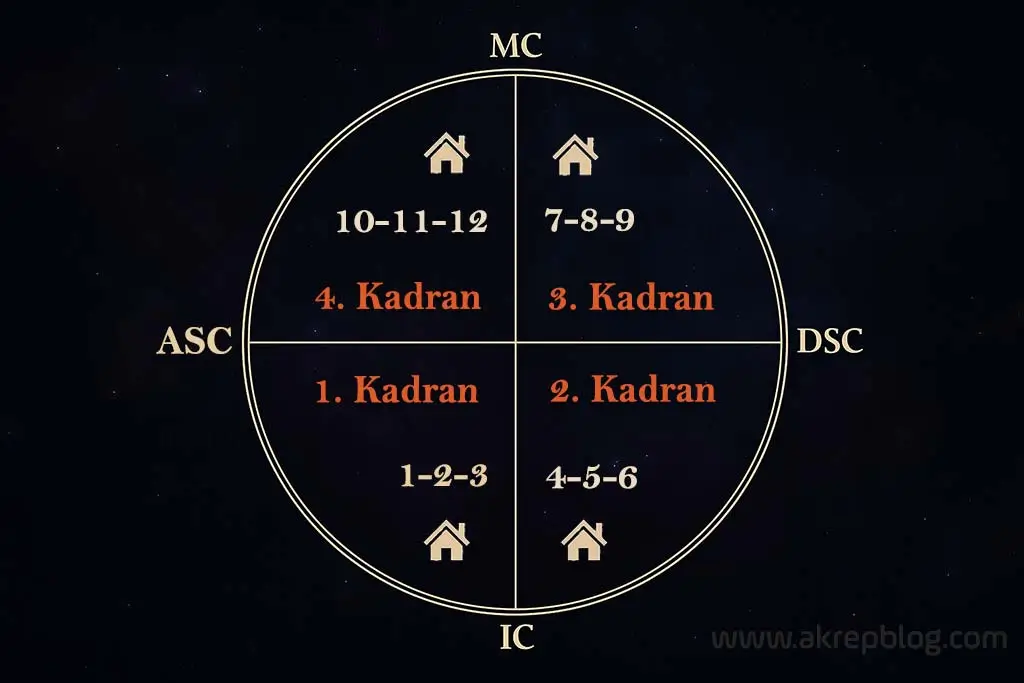
Map, Ascendant (ASC) , Descending (DSC) , Peak Point (MC) ve Bottom Point (IC) It is divided into four parts (quadrants) by lines.
Self-orientation (self-awareness) Individual development, identity, value judgments, communication style
Inner world and personal productivity Family, emotional foundation, art, work–service area
Relationships with others Partnership, sharing, beliefs, expansion, learning
The social world and the beyond consciousness Career, social environment, collective consciousness, spiritual direction
Meanings of the Dials
Quadrant 1 (Birth → Me)
- The area where self-awareness is born
- The answer to the questions “Who am I?”, “What do I want?”
- Themes of beginning, self, self-confidence, individuality
Quadrant 2 (Home → Labor)
- The area that roots personality
- Family, childhood, home life, the way he puts his talents into practice
- The theme “How do I keep myself safe?”
Quadrant 3 (Relationship → Expansion)
- Contact with the outside world
- Marriages, sharing, shared learning
- The question “What am I building with other people?”
Quadrant 4 (Society → Spirit)
- Contribution to society, profession, career direction
- Collective consciousness, service, spiritual transformation
- The question “What mark do I leave on society?”
The distribution of planets in quadrants in a chart indicates in which area the person's energy is concentrated:
- In quadrants 1–2 intensity → individual and internal orientation
- In quadrants 3–4 intensity → interpersonal and social orientation
The four quadrants in the natal chart represent the four stages of life's journey:
Self → Inner world → Others → Society.
Each of them consists of three houses and together they describe the cycle of a person's personal, social and spiritual development.
Universally Used Dial Systems
The quadrant system used in the natal chart is not actually a single approach. While the meanings of these sections are common across both classical and modern schools of astrology, their naming and interpretation vary. Therefore, understanding the quadrants is not simply a matter of viewing a chart divided into four quadrants; each school shapes these areas according to its own knowledge system. This enriches interpretation and offers a deeper perspective.
In the most commonly used system, the map is divided into four regions by the intersection of two main axes: ASC–DSC ve MC–IC .
These axes function like a compass, defining the relationship between a person's inner world and the outer world, the boundaries between self and others, and individual living spaces and social orientations. Many astrologers therefore view quadrants as the "fundamental directions of the chart."
Some sources associate quadrants with life cycles. Accordingly, the first quadrant represents birth and personal awareness, the second quadrant represents production and maturation, the third quadrant represents relationships and involvement in life, and the fourth quadrant represents social contribution and maturity. This classification is particularly common within the psychological school of astrology.
Some schools of thought use the dials internal and external orientation The lower half of the chart represents inner development, while the upper half represents reflection on the external world. Similarly, the left side of the chart is seen as the area where personal initiative predominates, while the right side is shaped by relationships. When this dual structure is combined, the quadrants allow for an analysis of a person's life experience through the lens of four main motivations.
These different systems point to the same fundamental truth: Quadrants are broad frames that indicate where energy is concentrated in the chart. Accurately interpreting the quadrants is a fundamental step in understanding the primary direction in a person's life, the themes around which they make decisions, and the areas where their willpower is most active.
The Place of Quadrants in Psychological Astrology
Psychological astrology views a birth chart not merely as a predictor of events, but as a profound influence that shapes one's life experience. psychological architecture In this approach, the quadrants constitute the broadest and most decisive framework of the chart. Because the energy distribution of the quadrants often determines how a person perceives the world, how they express themselves, how they motivate themselves toward their goals, and how they behave in relationships.
According to psychological astrology, the lower half of the chart represents the inner world, while the upper half represents the opening to the outer world. The left half represents individual initiative, and the right half represents relational orientation. When these two axes come together, the four quadrants that emerge indicate how a person "views" life, what motivates them, and the level at which they interact with events. For example, someone with most planets in the upper half of their chart tends to be oriented toward the outer world, while someone with a predominance in the lower half interprets life from a more internal perspective. Similarly, left-sided dominance strengthens personal will, while right-sided dominance reveals a perception of life shaped by relationships.
This perspective demonstrates that quadrants are not merely technical distinctions but also serve as a guide for understanding a person's conscious mind. Psychological astrologers consider quadrant density to be a person's fundamental orientation map. The first quadrant's weight represents strong self-construction, the second quadrant's weight represents the need for production and skill development, the third quadrant's weight represents learning through connection, and the fourth quadrant's weight represents identity formation through social contribution.
This evaluation of the quadrants offers the opportunity to consider the chart as a holistic psychological structure, rather than simply its individual parts. While signs, planets, and houses provide more detailed interpretations, the quadrants are the primary drivers determining the perspective from which these details are experienced. Therefore, in psychological astrology, quadrant analysis is considered one of the first steps in chart interpretation.
Which Quadrant Means What?
4 parts of the birth chart, their meanings and their reflection on our lives
The four quadrants of a natal chart are broad thematic areas that indicate the directions in which a person's life energy flows. Each quadrant represents a different motivation for life, and this motivation becomes more pronounced when the planets are intensified. The quadrants also reveal how a person perceives events, prioritizes them, and enters life through which door. Therefore, examining each quadrant individually is a fundamental step in understanding the chart's psychological underpinnings.
Quadrant 1 – ASC to IC (1st, 2nd and 3rd House Energy)
Individual initiation, inner awareness and self-construction.
The first quadrant is the area where a person constructs their life "from the inside out." When the planet is intense, individuality, independence, and personal will come to the forefront. A person interprets life from their own center; the question "Who am I?" forms the backbone of life. A strong emphasis in this quadrant allows a person to embark on new beginnings with courage, make their own decisions, and maintain their individual stance. Internal impulses, rather than external influences, motivate them on the path of life.
When the first quadrant is dominant, a person naturally tends to prioritize their own needs. This isn't a selfish attitude; rather, it's a result of a need to know themselves, define their boundaries, and act independently. As a person develops themselves, it becomes easier to open up to the outside world. This quadrant also offers a strong sense of initiative and the opportunity to experience their own power.
Quadrant 2 – IC to DSC (4th, 5th and 6th House Energy)
The area of production, skill development, labor and life organization.
The intensity of the second quadrant indicates that a person constructs their life around "developing talents and increasing productive capacity." When planets are strong in this quadrant, a person naturally tends to work, improve, establish order, and take responsibility. It's not as individualistic as the first quadrant, nor as relational as the third; the emphasis is more on taking concrete steps, making life productive, and striving to develop their own resources.
This placement suggests that a person derives their inner confidence through productivity. As they work, establish order, or improve an area, they feel more powerful. Routines, practical skills, developing talents, and the steady progression of life constitute the fundamental motivations of this quadrant. When energy is concentrated here, a person naturally assumes life's responsibilities; the quest for stability becomes more pronounced.
Quadrant 3 – DSC to MC (7th, 8th and 9th House Energy)
A space for relationships, cooperation, social interaction, and experiencing the outside world.
The third quadrant intensity is when one's will is mostly interacting with others It indicates that the planets are working. The accumulation of planets in this quadrant drives a person to develop through relationships. A person defines themselves through their reactions to others and places cooperation, partnership, and social bonds at the center of their lives. A strong emphasis in this area enhances social intelligence; a person develops a natural ability to understand others, adapt, and manage relational dynamism.
When the third quadrant dominates, a person gains motivation through interaction with others rather than through solitude. The meaning of life is sought through interaction. This quadrant also encourages learning, exploration, and seeing the world from different perspectives. A person grows through relationships; their horizons are broadened by the experiences of others.
Quadrant 4 – MC to ASC (10th, 11th and 12th House Energy)
Social contribution, collective consciousness, sense of purpose and spiritual depth.
The fourth quadrant is the area where a person connects their life energy with society. When the planets converge here, individual motivation is replaced by a broader pursuit of purpose. A person defines their identity through social contribution, career goals, group consciousness, or larger ideals. The dominance of this quadrant paves the way for a person to channel their inner creativity into the outside world, channel their potential for collective benefit, and desire to leave a mark on life.
The fourth quadrant also represents a person's spiritual depth and the way they give meaning to life. This intensity leads them to care not only about their own lives but also about the development of society. Career, goals, social responsibility, and broader perspectives constitute the core themes of this area.
What Happens in Which Quadrant of the Chart is the Planet Density?
The concentration of most planets in a quadrant in the natal chart causes a person's life energy to flow into a specific area. This intensity is a powerful indicator that determines a person's behavior, internal motivation, and life course.
Quadrant 1 Intensity – The Individual Living from the Inside Out
Personal will and individual orientation are strengthened.
This intensity makes a person independent of external influences. A person first hears their inner voice and then steps into the outside world. Their decisions are driven by their own needs, rather than the expectations of the outside world.
Start-up energy and entrepreneurship increase.
The person has a natural courage to embark on a new endeavor, chart his own path, and structure his life from his own center.
The need for self-knowledge becomes evident.
The fundamental question of life is, "Who am I?" A person does not want to settle into any external structure without understanding himself.
Quadrant 2 Intensity – Production, Skill, and Order-Centered Living
Life energy is directed towards the area of producing, establishing order and taking responsibility.
This intensity creates a person's motivation to work, develop, improve and make daily life productive.
Inner confidence is nourished by practical successes.
As a person achieves something, improves a skill, or establishes order in their life, they feel more powerful.
Progress, the search for stability and achieving concrete results come to the fore.
In life, confidence is built on concrete foundations; one's mind is focused on the question "how can I do better?"
Quadrant 3 Intensity – Life Flow Shaped by Relationships
A person defines himself/herself through relationships and social interactions.
Energy is directed toward the outside world, toward connection and cooperation with others. A person finds meaning in community rather than in solitude.
Decision-making processes are affected by relational dynamics.
A person considers the people around him, partnerships, and interactions before taking a step.
Social intelligence, diplomacy, and mutual understanding are strengthened.
This intensity enhances communication skills; one develops a natural depth of understanding of people's motivations.
Quadrant 4 Intensity – Social Purpose and Broad Perspective
Life orientation is shaped around social contribution, goals, and larger ideals.
People want to share their own production with society. Individual goals can, over time, transform into a collective goal.
Career, visibility and social responsibility awareness are strengthened.
A person's will operates not only within a personal framework but also within a broader social framework. Goals take on a dimension that affects the lives of others.
The search for spiritual depth and meaning becomes evident.
The person questions the purpose of life; the tendency to see oneself as part of a larger whole increases.
Dials and Will
How Does One Lead Life?
In a natal chart, willpower isn't limited to planets like the Sun or Mars. To understand the axis on which a person directs their life, it's necessary to look at the distribution of the planets in their quadrants. The quadrants represent the willpower what theme does it feed on? , a person's life from what perspective you understand and their decisions with what motivation In a sense, it reveals the internal working order of the will.
Quadrant 1 Willpower – Inner Drive and the Power to Chart Your Own Path
Willpower is fueled by intrinsic motivation.
A person acts according to their own desires rather than the expectations of the outside world. Therefore, decisions are more independent, more original, and more direct.
The “I want it, I will do it” approach comes to the fore.
People with a high concentration in this quadrant want to manage life within their own sphere of control. Willpower is combined with personal freedom.
The initial energy is strong.
When starting a task, a person does not seek external approval; his will works through the inner spark.
Quadrant 2 Will – Willpower Based on Production, Improvement, and Labor
Willpower is motivated by the need to achieve concrete results.
A person becomes motivated when they want to produce, improve, or organize something. Energy flows through effort and practical steps.
Stability strengthens the will.
An orderly life, planned progress and a sense of responsibility form the building blocks of willpower.
“Learning by doing” is at the heart of willpower.
A person becomes stronger with experience rather than theory; as he takes steps, he exhibits a more determined stance.
Quadrant 3 Will – Will Based on Relationships and Interaction
Willpower is affected by relationship dynamics.
Rather than making decisions alone, individuals are guided by feedback from relationships. Decisions often have a motivation shaped by interaction.
Cooperation strengthens the will.
When a person works toward a goal with others, they become more determined and focused. Partnerships increase the power of willpower.
Social ties are at the centre of decision-making processes.
The question “What can we do?” becomes as important as “What do I want?”
Quadrant 4 Will – Will Based on Social Purpose and Broad Perspective
Willpower is fueled by a broad sense of purpose.
A person's motivation is not limited to his or her own needs; the desire to move towards a greater goal, social benefit or a collective direction becomes evident.
The sense of purpose becomes the center of the will.
People with a high concentration in this quadrant demonstrate significant determination when they set a goal. Willpower is strengthened by answering the question, "What purpose do I serve in my life?"
Holistic thinking shapes the will.
A person makes decisions by evaluating not only the present but also the future and the bigger picture.
Quadrants and Personality Dynamics
How Does It Shape The Way We See Life?
The quadrants in a natal chart provide a powerful psychological framework that determines how a person perceives the outside world, where they define themselves, and through what lens they view life. While the signs and planets represent a person's qualities, the quadrants represent the from what perspective it is experienced Quadrants are therefore the cornerstone of personality dynamics. How a person interprets events, what they prioritize, where they draw strength from, and under what circumstances they struggle—the quadrant distribution underlies all of this.
Quadrant 1 – Self-Centered Perception
A person interprets life by starting from himself first.
People with a dominant quadrant in this area interpret events through their own feelings, internal motivations, and personal experiences. Their personality structure includes a strong sense of self-direction and independence.
Personal boundaries and individual needs are clear.
A person wants to define themselves clearly. Psychologically, they seek an answer to the question, "Who am I?"
Quadrant 2 – Functionality and Competence-Centered Perception
Evaluates life in terms of skill development and practical results.
This personality structure focuses on the practical side of things. A person creates themselves by creating, organizing, and improving themselves.
The feeling of confidence is strengthened by concrete achievements.
Psychologically, a person may feel incomplete during periods when he or she is not productive; however, when he or she establishes order, he or she feels relieved.
Quadrant 3 – Relational and Social Perception
A person sees himself in the mirror of relationships.
When this quadrant is dominant, a person understands who he or she is from the reactions of others, relationships, and interactions.
Empathy, harmony and social intelligence are at the forefront.
Life is shaped by the bonds we form with others. Personality structure is nourished by collective experiences.
Quadrant 4 – Perception with a Social Perspective
The person sees life as part of a larger whole.
This dominance causes social role, career, sense of purpose and vision for the future to gain importance in personality.
The desire for self-actualization is broad.
A person is interested not only in his own development but also in the meaning of his work and the mark he leaves on the world.
Dial Imbalances
The Psychological Consequences of Overintensity and Under-Quadrant
- Over-concentration can lead to over-focusing on a single area.
- The missing quadrant indicates the need to learn and balance that theme.
- Imbalance can create distinct trends and difficulties in personality structure.
Excessive concentration of energy in one quadrant in the natal chart or a quadrant remaining completely blank This can create a significant imbalance in a person's life experience. This isn't always negative, but it can cause a person to focus on a single theme and delay developing other areas of life. Astrologically, imbalance is a sign of growth potential. While a person experiences the energy flow naturally in the area where they are strong, they must learn the themes of the quadrant that are lacking over time through experience.
Extreme density In this case, a person develops natural strength and expertise in the area represented by a particular quadrant; however, this strength can sometimes reduce a person's resilience. For example, an excessive dominance of the third quadrant can cause a person to constantly seek meaning through relationships and struggle when alone. Similarly, when the first quadrant is overly intense, a person may be very strong in independence but may expend more effort in areas requiring collaboration. Therefore, intensity is both an advantage and a testing ground for awareness.
Missing dial This doesn't mean that the subject will never exist in a person's life; on the contrary, it points to the need to develop that theme. Even if the energy isn't innate, life experiences confront a person with that area of deficiency. For example, someone with an empty fourth quadrant will be guided over time to take responsibility for their career, mission, and social role. The deficiency is actually potential for growth; it can shape the direction of a person's life experiences.
Therefore, quadrant imbalances are one of the most important areas of awareness in a chart. They indicate which themes a person naturally flows with and which themes they will develop later. Astrologically, these imbalances point to lessons to be completed on a person's journey and offer important clues to understanding life's direction.
Reading the Quadrants with Elements and Modalities
- The quadrants represent life orientation, the elements represent the internal rhythm of nature, and the modalities represent the form of movement.
- When all three are read together, the basic character structure of a person becomes much clearer.
- Dial intensity can reinforce or balance element and modality imbalances.
While the quadrants show which area of life the energy flows to in the birth chart; the elements (Fire, Soil, Air Defence, Su) this energy with what qualifications that it works, modalities (Öncü, Constant, Variable) whereas how you move Considering these three themes together provides a holistic understanding of the chart's behavioral, psychological, and motivational aspects. The quadrants alone represent a person's life direction, but when combined with the distribution of elements and modalities, how this direction is experienced becomes much clearer.
For example, while a person with a strong first quadrant may act with individualistic tendencies, if the fire element is strong, they express themselves spontaneously, while if the earth element is dominant, they proceed with more controlled and concrete steps. Similarly, a chart with a dominant third quadrant indicates a social nature; however, if the water element is strong, the person acts more emotionally and intuitively in relationships, while if the air element is dominant, communication and mental interaction become prominent. Even if the quadrant orientation remains the same, the internal rhythm determined by the elements can completely alter how this orientation is experienced.
Modalities, on the other hand, determine the flow of the quadrants and the individual's internal dynamism. Someone with a strong pioneering modality tends to initiate quickly, regardless of their quadrant; with a third-quadrant dominance, this individual may take the lead in social projects. Someone with a strong fixed modality, on the other hand, can display exceptional determination when focusing on a specific quadrant; with a second-quadrant intensity, this individual can achieve very strong stability in the production cycle. Mutable modality, on the other hand, flexes the quadrant's influences; with a fourth-quadrant intensity, this individual can expand their social goals to different areas over time.
Therefore, the quadrants can be thought of individually as directions, the elements as energy quality, and the modalities as modes of movement. When all three are read together, a much more coherent understanding of how a person experiences life, responds to events, and manifests their energy is achieved. Quadrant density, in particular, tends to balance or amplify elemental and modality deficiencies, making the chart a more layered structure.
Understanding Life Cycles with Dial Interpretation
- Transits and progressions emphasize certain quadrants during certain periods.
- The activation of the quadrant indicates a temporary shift in the life theme.
- A person experiences faster development in the area represented by the quadrant of intensity.
Quadrants not only provide a permanent structure in the natal chart; they also serve as a powerful guide for understanding a person's life cycles over time. The intense presence of transiting planets in a quadrant, or the activation of progressions in a particular quadrant, clearly indicates the theme of life's focus at that time. Thus, it is possible to track periods of awareness, periods of change, and psychological shifts in orientation in a person's life through the quadrants.
For example a when the transit cycle activates the first quadrant A person naturally experiences an inner renewal; identity, willpower, courage, and personal beginnings come to the fore. This period is a time when the individual returns to their center and makes independent decisions. When these same transits enter the second quadrant, the focus shifts to productivity, establishing order, developing skills, and responsibility. The person may establish new routines in their professional life or take steps to achieve greater stability.
During periods when the third quadrant is active Relationships, partnerships, collaborations, and social interactions increase significantly. A person develops themselves through communication, sharing, and social connections. This period is generally a time for learning from others, expanding their social circle, and growing through relational experiences. Cycles in which the fourth quadrant is active indicate significant developments regarding social roles, goals, careers, and collective orientations. A person may take on greater responsibilities in their life, and their vision for the future may become clearer.
Transits and progressions By temporarily increasing the energy of the quadrants, it reveals new periods in a person's life path. These periods can reinforce the fundamental orientation in their natal chart or present a completely new realm of experience. During such times, a person becomes more aware of their inner transformations and has the opportunity to more consciously observe where their life's focus is shifting. Therefore, quadrant interpretation is considered a powerful timing tool for understanding life cycles.
Using Quadrant Analysis with Other Indicators and Structures on the Map
- The quadrants show the general direction of the chart; the other indicators explain how that direction is experienced.
- Planetary aspects, element–modality distributions, and house placements can strengthen or soften the quadrant effect.
- Holistic interpretation requires understanding how the quadrant energy interacts with the entire chart.
Quadrant analysis is a powerful starting point for understanding the fundamental orientation of a natal chart, but it alone does not complete an interpretation. When considered in conjunction with other indicators in the chart, quadrants gain a much clearer and more profound meaning. Therefore, astrologers often consider quadrants as a "main frame" and interpret by placing all other astrological elements within this framework. This allows for a comprehensive and detailed examination of a person's life trajectory.
Planetary angles , particularly intense aspect patterns (such as a T-square, Grand Trine, Yod), influence how the quadrant energy flows and where it is concentrated. For example, a chart concentrated in the third quadrant, when combined with hard aspect patterns, can indicate challenging but enriching experiences learned through relationships. This same intensity, when combined with supportive aspects, can produce social success, cooperation, and harmonious relationship dynamics. Therefore, aspect patterns are a key area of interaction that determines how the quadrant "works."
Element and modality distributions The first quadrant determines the "quality" of its energy. In a fire-dominant chart, the intensity of the first quadrant generates great entrepreneurial power, while in a water-dominant chart, this intensity can translate into more intuitive and inner development. Similarly, the modalities determine the speed, stability, and flexibility of the quadrant's orientation. The cardinal modality allows for rapid breakthroughs in the area represented by the quadrant, while the fixed modality provides depth and stability, while the mutable modality brings harmony and versatility.
House settlements The house also details the influence of the quadrants. For example, in a chart dominated by the third quadrant, 9th house placements can encourage a person to explore the world and expand their cultural reach. The 11th house energy, combined with a fourth quadrant dominance, supports the individual in pursuing social goals in group settings. Thus, the house details transform the general orientation offered by the quadrant into a more concrete life experience.
Quadrant analysis isn't a single conclusion; when combined with other elements in the chart, it becomes a truly powerful guide. Understanding a person's life direction is possible by evaluating all the indicators that influence it together. The quadrants are the starting point for this assessment, but a holistic interpretation emerges from the integration of all the components.
Frequently Asked Questions
What does a quadrant mean in a natal chart?
A quadrant is one of four main areas in the birth chart that reflects the fundamental areas of life where the planets are directed. These areas provide insight into how a person uses their energy, the perspective from which they view the world, and the themes through which they experience life.
Why is dial density important?
The concentration of planets in a particular quadrant determines a person's fundamental life direction. The quadrant in which the intensity is located clearly indicates the area in which a person's decisions, behavior, and willpower are nourished.
Is it bad for the dials to be empty?
No. A blank quadrant doesn't indicate the absence of that area, but rather that the person will develop that theme over time through life experiences. A missing quadrant indicates the potential for learning and maturation.
How does quadrant density affect personality structure?
Quadrant intensity determines the center of a person's perception of life. For example, the first quadrant intensity strengthens individuality, while the third quadrant intensity creates a relational personality structure. Each quadrant represents a different psychological orientation.
Do transits and progressions change the quadrant effect?
Yes. Transiting planets and progressions activate certain quadrants during certain periods, causing a temporary shift in a person's life theme. This can affect a person's priorities, decisions, and psychological orientation.
What is the relationship between quadrants and element–modality?
The quadrants represent the direction of life, the elements the quality of energy, and the modalities the pattern of movement. When all three are read together, a person's motivational structure becomes much clearer. Dial intensity can reinforce or balance elemental or modality imbalances.
What does dial intensity mean in relationships?
Intensity in the third quadrant, in particular, indicates a person's tendency to live a relationship-focused life. The person defines themselves through interaction with others. Other quadrants can also influence relationships in different ways; for example, the first quadrant may reinforce themes of independence, while the fourth quadrant may reinforce themes of social responsibility.
Do quadrants determine career orientation?
A fourth-quadrant intensity indicates a natural inclination toward career and social life. However, career interpretation should be made holistically, considering not only the quadrants but also the 10th house, Sun, MC, and aspect structures.
Is quadrant analysis alone sufficient?
Quadrant analysis is a powerful starting point for understanding the overall orientation of a chart, but it doesn't explain the entire chart on its own. It's most accurate when read in conjunction with houses, planets, aspect patterns, elements, and modalities.
What does it mean if there is no density in any quadrant in my chart?
This indicates that a person can experience life in a more balanced way. Energy is distributed across different themes rather than a single area. A person can be flexible, versatile, and open to a variety of life experiences.
WRITE A COMMENT
VISITOR COMMENTS - 0 COMMENTS