
How to Calculate Transit Map Calculations?
Subject Content
What does a transit map show and how is it calculated?
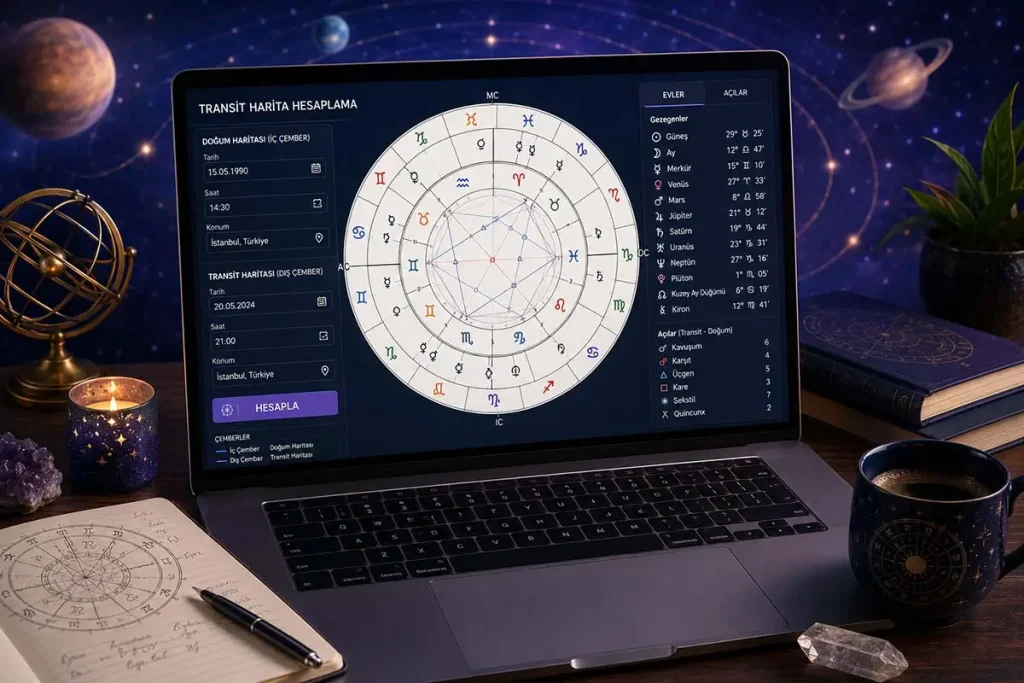
Transit map calculation This allows you to see which houses the planets in the sky on a specific date were passing through in your birth chart and which aspects they formed with your natal planets. The calculation uses your date of birth, time of birth, place of birth, and the transit date you wish to examine. The system keeps your birth chart fixed while overlaying the current planetary positions for the selected date onto the chart.
In the resulting double chart, the inner circle mostly represents the natal chart, while the outer circle shows the transiting planets. This allows you to see which house Saturn is transiting through, whether Jupiter is forming an aspect with your natal Sun, or whether Uranus is triggering a significant chart point.
However, a transit map is not simply a forecasting method that answers the question "what will happen today?". The map primarily shows which issues are gaining momentum during a specific period, where pressure is building, and where opportunities for development exist. The same transit can produce different results in different people. This is because the house the transiting planet is passing through, the aspects it forms, the structure of the natal chart, and other indicators active during the same period are all different.
What information is needed to calculate a transit map?
The accuracy of the calculation depends particularly on the correct entry of information such as the time and place of birth.
To create a personal transit chart, your birth chart must first be calculated. The following information is used for this:
- date of birth,
- birth time,
- birthplace,
- The date on which the transit map will be examined.
- Transit location and time, if necessary.
The date of birth determines the sign and degree positions of the natal planets. The time of birth is necessary to calculate the rising sign, the initial degrees of the houses, and the houses in which the planets are located. The place of birth ensures the accurate determination of the time zone and geographical coordinates.
Transit date This shows the current positions of the planets in the sky. For example, if you want to examine today's effects, you can select the current date. If you want to evaluate the date of a job interview, move, exam, or important decision, you can enter the relevant day and time.
If the time of birth is unknown, transit aspects between planets can still be examined; however, house placements, ascendant, and angular points may not be reliable. Therefore, the correct birth time is important, especially for questions like "In which house is Transit Saturn in me?".
What are the steps for calculating a transit map?
When the birth information and the date to be analyzed are entered correctly, the chart can be created in a few steps.
Firstly Transit Map Calculation Open the tool. Then enter your date of birth as day, month, and year. Add your time of birth, including minutes and seconds, as much as possible.
In the place of birth field, select the city where you were born. If no district or smaller settlement is found, the closest city to your place of birth and within the same time zone can be used. However, in cases where ascension degree is sensitive, the exact location should be preferred. If your place of residence is not registered, you can also enter the coordinates manually by checking the "I cannot select a city, I will enter the coordinates manually" box.
Next, select the day you want to examine from the transit date section. The calculator may default to the current date. You can choose a past date to examine the celestial indicators of a past event, or a future date to assess the overall potential of a future period.
Enter your current location in the transit location field. For short transits, and especially when the Moon is in a specific position, the time and location become more important. With heavy planets, a change of city does not alter the planet's degree; however, it may affect the beginning of the house.
After checking the information, press the calculate button. The system will generate a transit chart showing your birth chart along with the sky positions for the date you selected.
How to Select Transit Date and Location?
The chosen date should be determined according to the question being answered; the same time frame cannot be used for every topic.
If daily mood, communication, meetings, or short-term movements are to be examined, a specific day and time can be chosen. With faster-moving planets like the Moon, Mercury, Venus, and Mars, even a difference of a few hours or days can change the direction of the interpretation.
With slow-moving planets like Saturn, Uranus, Neptune, and Pluto, a broader period should be considered rather than focusing on a single hour. These planets can remain in the same degree area for extended periods and, due to retrograde motion, may form aspects to the same natal point multiple times.
For example, if transiting Saturn is square to your natal Sun, it's not enough to only examine the day the aspect becomes exact. The period when Saturn begins to approach the aspect, the date of exact aspect, its retrograde repetition, and its withdrawal process must all be considered together.
The transit location may differ from the place of birth. If a person lives in another city, they may want to examine the house placements on the transit map according to their current location. However, the basic transit angles do not disappear when a person moves to a different city.
Which indicators should be looked at first on a transit chart?
The map may contain numerous lines and symbols; it's best to begin interpretation with the strongest indicators.
First, one can look at which houses the slower-moving planets are transiting. Transits of Jupiter, Saturn, Uranus, Neptune, and Pluto indicate longer periods. The houses these planets are passing through can describe areas in a person's life where there is a need for more development, organization, change, confronting uncertainty, or transformation.
Secondly, the aspects that transiting planets form with the natal Sun, Moon, Mercury, Venus, Mars, Ascendant, and MC are examined. Transits to personal planets and the angular points of the chart are more noticeable and perceptible.
Thirdly, the type of aspect and its orb value are considered. Conjunction, square, and opposition aspects can create more pronounced mobility. Trine and sextile aspects can support the easier utilization of existing potentials. However, a supportive aspect alone may not produce results if the person takes no action.
The distance of the angle from the exact degree is also important. If the transiting planet is approaching the natal point. approaching angle if they reached the same degree round angle if it deviates from the exact degree receding angle This is considered the importance of this distinction. Orb value in transits This can be examined in more detail.
How to Interpret a Transit Map?
For a sound interpretation, planetary, house, aspect, and natal chart indicators should be considered together.
A basic sequence can be followed when interpreting transit maps:
- What does a transiting planet represent?
- Which natal house does it pass through?
- Which natal planet is it forming an aspect with?
- What type of angle is it and what is its orb value?
- Is the angle approaching, finalized, or receding?
- What other transits are active during the same period?
- Is there a similar angle or significant angle pattern in the natal chart?
For example, if transiting Saturn squares the natal Sun while passing through the 10th house, career, responsibility, authority, goals, and how one expresses oneself may be questioned more seriously. This aspect should not be interpreted as a guarantee of job loss. For one person it may mean taking on more responsibility, for another a change of career direction, and for yet another, finally completing a long-delayed task.
Similarly, a transit of Jupiter through the 2nd house alone doesn't necessarily indicate a guaranteed increase in money. It can manifest in different ways, such as increased income opportunities, a desire to expand existing resources, or growing expenses. To understand the outcome, the houses Jupiter rules and the aspects it forms with natal planets must also be considered.
Does the transit chart change if the birth time is incorrect?
Errors in birth time can cause significant differences, especially in ascendant, MC, and house placements.
If the birth time is a few minutes off, the ascendant degree and house beginnings can change. Even small time differences can cause a planet to appear in a different house, especially with rapidly rising signs or planets very close to the house entrance.
If the birth time is off by an hour or more, the Ascendant, MC, and all house placements can change. In this case, interpretations based on which houses the transiting planets are passing through lose their reliability.
In contrast, the sign and degree positions of natal planets are largely preserved. Therefore, interplanetary aspects, such as the square that transiting Saturn makes to the natal Sun, can be examined. However, one should not definitively state whether the transiting planet is passing through the 6th or 7th house.
If the time of birth is unknown, we can narrow down the time range based on life events. Rectification calculation You can use this tool to correct your birth time.
Does the transit map show the exact event?
Transits It can indicate the dominant themes and timing of a period; however, a definitive conclusion cannot be drawn from a single indicator.
A transit chart shows which areas a person might focus on more during a particular period. However, a transit doesn't produce the same effect in every person. This is because the same planetary transit falls into different houses and forms aspects with different planets in different birth charts.
Often, multiple indicators supporting the same theme are needed for an event to become visible. While a heavy planetary transit lays the groundwork for a long period, a rapid Mars, Sun, or Moon transit can set the matter in motion. Progress, Solar Arc, Solar Return ve Moon Return The presence of similar themes in their maps may also enhance the significance of the period.
Therefore, the transit map is not intended to make definitive statements that would create fear; It should be used to understand the conditions of the time, identify areas requiring attention, and evaluate decisions more consciously.
For more detailed information on how transits work and their effects on houses and planets, see [link to relevant documentation]. What are Transits? Planetary Transits in a Natal Chart You can review the article.
general evaluation
Calculating transit charts is easy; the real challenge lies in interpreting the calculated indicators together.
To create a transit chart, you enter your date of birth, time of birth, place of birth, and the transit date to be examined. After the calculation, the houses through which the current planets are transiting in the natal chart and the aspects they are forming are examined.
The interpretation can begin by examining the aspects of heavier planets to personal planets, corner points, and narrow orb values. Then we can look at when these long-term themes are triggered by fast-moving planets.
A single transit is not proof of a definitive event. The nature of the planet, the house it passes through, the natal planet it aspects, the orb value, retrograde repetitions, and the overall structure of the chart must be considered together. Thus, the transit chart ceases to be merely a daily forecasting tool and becomes a timing method that helps individuals understand the period they are in more consciously.
Frequently Asked Questions
When calculating a transit chart, the most frequently asked questions concern the importance of the birth time, date selection, free calculation tools, and how to read the results. The answers below provide brief explanations of questions encountered during the basic calculation and interpretation process. It should be remembered that personal results should always be evaluated in conjunction with the natal chart as a whole.
Can transit maps be calculated for free?
Yes. You can create a free transit chart by entering your birth information and the date you wish to examine. To do this... Transit Calculation You can use this tool. The results screen will show the positions of transiting planets in the natal houses and the aspects they form with the natal planets.
Is the time of birth required for a transit chart?
Birth time is not always necessary to analyze the angles between planets. However, knowing the birth time is essential to accurately determine the ascendant, MC, and which houses transits are passing through.
What date should be entered on the transit map?
For current effects, enter today's date; for examining indicators of a past event, enter the date of the event; and for a future period, enter the date you wish to evaluate.
Which planets are most important in a transit chart?
Jupiter, Saturn, Uranus, Neptune, and Pluto represent long-term periods. The Moon, Mercury, Venus, and Mars, on the other hand, may indicate shorter-term developments and the times when themes formed by heavier planets become active.
How long is the transit map valid?
The duration of the transit varies depending on the planet, event, and your purpose for examining the transit chart. While a lunar transit may be effective for a few hours or days, transits of Saturn, Uranus, Neptune, and Pluto can last for months or years.
Does a transit map accurately predict the future?
No. A transit chart shows issues and possibilities that may come to the forefront during a specific period. A single transit is not sufficient for a definitive conclusion; the natal chart, other timing methods, and the individual's current circumstances must be considered together.


WRITE A COMMENT
VISITOR COMMENTS - 0 COMMENTS